At a Glance
Buying glasses online? Your pupillary distance (PD) is just as important as your prescription. A PD that’s even a few millimetres off can affect comfort, especially with stronger prescriptions or progressive lenses.
What you’ll learn:
- What pupillary distance (PD) is and why it matters
- The difference between single PD and dual (monocular) PD
- When to use near PD versus distance PD
- How to measure your PD at home using four different methods
- When DIY measurements are reasonable and when professional measurements are recommended
- Common PD mistakes that can cause blurry vision, headaches, or eye strain
- How PD affects online glasses orders
Now that you’ve gotten your comprehensive eye exam and have your prescription, you’ll need one more thing before you can order that pair of frames that caught your eye online. The online order will ask for your PD Measurements.
Your Pupillary distance, or PD measurement, is the millimetre distance between your pupils. It tells the lab where to centre each lens. Without your PD measurement, you may end up feeling woozy when wearing your new glasses even if your prescription is correct. Even reading a text can feel like trying to write on a moving bus.
This guide explains what PD is in glasses, how to take your own PD measurement at home with simple tools, when to use single vs dual, and how near vs distance PD affects comfort and clarity.
A quick real world note. Many patients pay for an eye exam, then discover the PD measurement is missing from the prescription printout. This is because PD is often taken during dispensing and not during the eye exam.
You can measure your PD at home or use phone apps to calculate the measurements for yourself. Be aware that phone apps can also give inconsistent numbers, which can be frustrating when you order online and don’t know if your glasses will work for you. If that sounds familiar, you are not alone. At Real Eyes Optometry in Burnaby, you can get a precise monocular PD measured by a professional, when buying spectacles at the clinic. Our goal is making sure you have clear vision that feels natural, without the runaround.
Reviewed by Dr. Amit Sahota, Registered Optometrist (BSc, OD)
July 10, 2026

What is PD in glasses
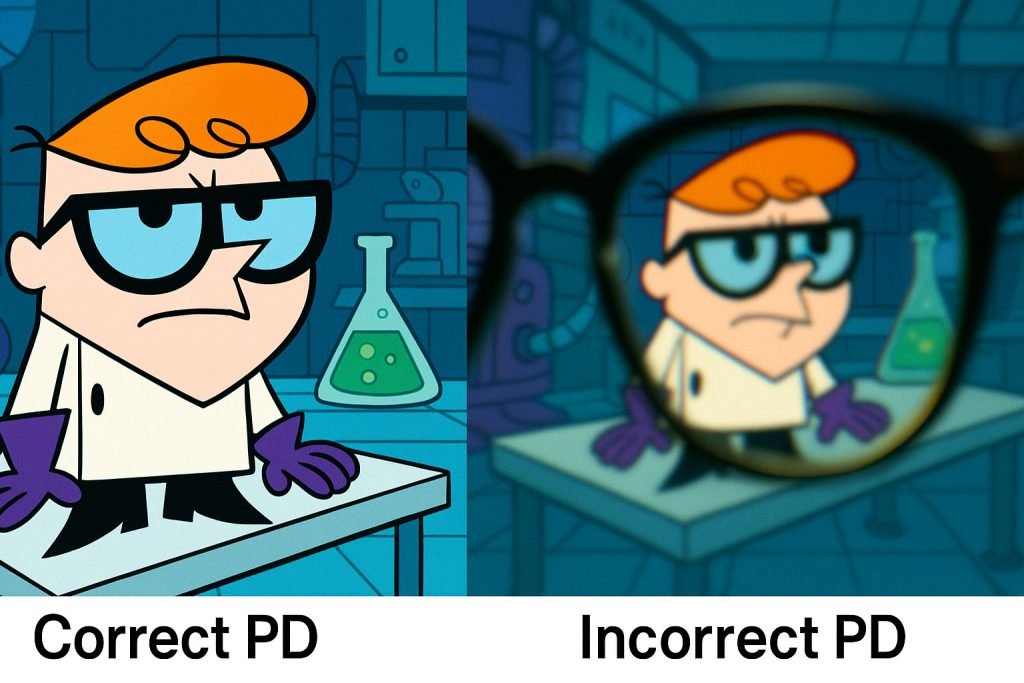
Pupillary distance is the space between the centres of your pupils, measured in millimetres. That number tells the lab where to place the optical centre of each lens in your frame. When your PD is aligned with the optics, your lenses feel natural and your eyes relax. When it is off, you can feel blur, eyestrain, pulling sensations when you scan side to side, or headaches that ease when you remove your glasses. PD is not lens power. It is positioning data that makes lens power usable in the real world.
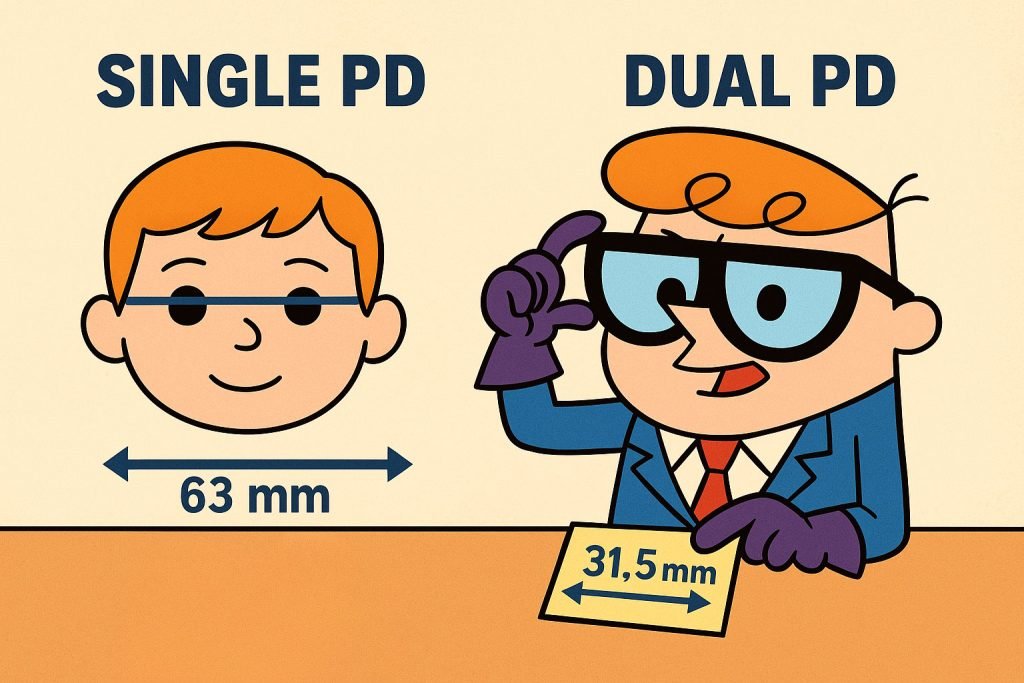
You will see PD written in two common formats. One number, for example 63 mm, is often called single PD or binocular PD. Two numbers, like 31.5 and 31.5 mm, are dual PD or monocular PD values, one for each eye measured from the bridge of your nose. Both describe where your pupils sit, they just use different precision. Dual PD captures facial asymmetry and tends to be more exact for complex lenses.
Why PD Measurements Matter More than People Think
Your brain expects the optical centre of each lens to sit directly in front of each pupil. When it does, what you see feels stable and clear. When it does not, your eyes work harder to focus on the image, which is why PD errors feel like eye strain. The stronger your prescription, the more sensitive you are to small centration mistakes. The same is true for designs like progressives and bifocals that depend on precise alignment.
In Canada, PD measurements are usually taken during the dispensing and fitting stage, which is why some prescriptions do not list it. That is normal. The measurement and final fine tuning happens when the frame is on your face, not during the refraction. If you prefer a professional to measure and fit your glasses, book an appointment at Real Eyes Optometry and let our dispensing team help you.
What is Single vs Dual PD, explained in plain language
Single PD is one number that spans from the centre of one pupil to the other. It is a quick measurement, and it works well for many single vision distance orders, especially at lower powers.
Dual PD, also called monocular PD, splits that total into two values. Think of it as right PD and left PD, each measured from the bridge of your nose. Most faces are not perfectly symmetrical. Dual PD captures that asymmetry so the lab can centre each lens where your eye actually sits. It is the preferred approach for progressive lenses, stronger powers, and anyone who wants the lowest chance of swim or edge distortion.
If you already have a single PD and an order form asks for dual PD, you can estimate by splitting the number in half, for example 63 becomes 31.5 and 31.5. That is a starting point, not a substitute for a measured monocular PD. When accuracy matters, measure both eyes separately.
Near PD vs Distance PD, and when to use each
Distance PD is measured while you focus far away. Near PD is measured at a close working distance, such as 40 cm for reading or 60 to 80 cm for computer work. Near PD is a little smaller because your eyes converge at close range. A simple rule many dispensers use for reading only glasses is to subtract around three millimetres from your total distance PD, or about one and a half millimetres from each side if you are using dual PD. For computer work, adjust based on the actual distance to your screen.
When to use which PD Measurement is straightforward.
- For single vision distance glasses, use distance PD.
- For reading only glasses, use near PD.
- For computer or intermediate glasses, use a PD matched to your real screen distance.
- For progressives and bifocals, your dispenser will set distance PD and then position the near optics based on your frame and fitting height.
What are Typical PD Measurement values, and why averages are not enough
Many adults fall in the low to mid sixties for single PD. Dual PD splits that into two numbers, one for each eye, typically in the low thirties. Children have smaller PD values that change as they grow. Averages are helpful for context, but they are a poor substitute for a real PD measurement. Small differences that do not matter at low powers can become noticeable at higher powers or with progressive designs.
How to Measure PD at Home Without Special Equipment
If you can visit a clinic, let a professional measure PD and finish your fit. If you must measure at home, take your time and repeat the steps to reduce error.
Method 1: How to Measure PD Yourself
- Stand in front of a well lit mirror at about twenty centimetres.
- Keep your head level, relax your brow, and focus on your own pupils.
- Close your right eye.
- Place the zero mark of a rigid millimetre ruler over the centre of your left pupil.
- Without moving the ruler, open your right eye and close your left.
- Read the millimetre mark that lines up with the centre of your right pupil.
Method 2: How to Meausure Your PD With a friend
- Have your friend sit opposite you, and focus on an object about 10 to 20 feet away to keep your eyes steady.
- Your friend will place a PD ruler on your face, lining up the “0” mark on the ruler with the center of your right pupil.
- The number on the ruler that aligns with the center of your left pupil is your PD.
That number is your single PD. Do three runs and average the results.
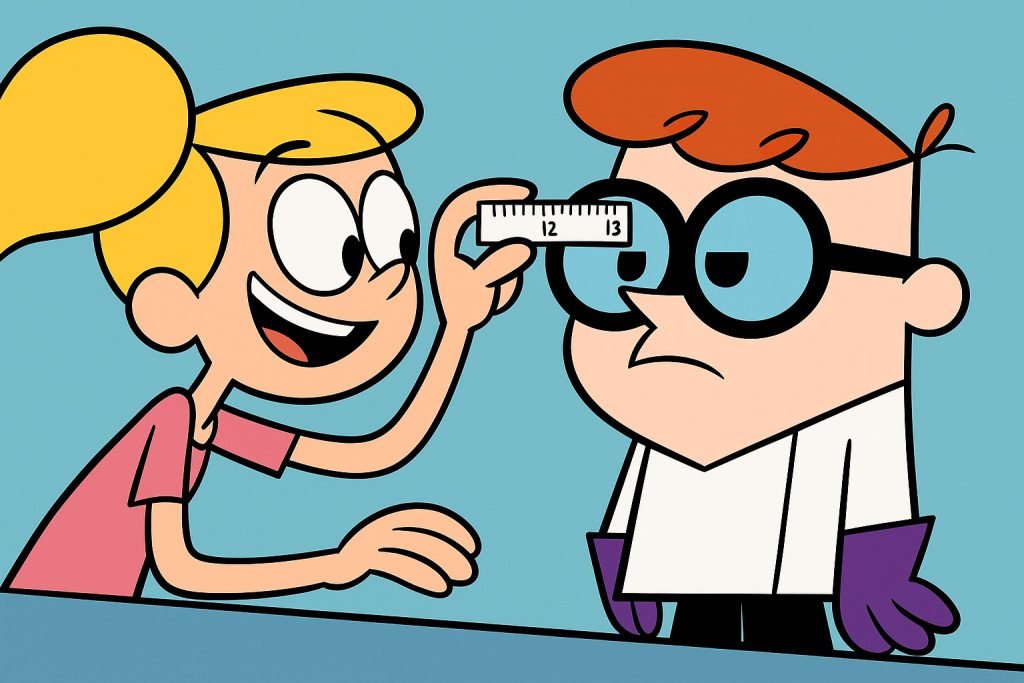
For dual PD, set the zero at the centre of the nose bridge.
- Measure from the bridge to the centre of your right pupil, note the value.
- Reset to zero at the bridge and measure to the left pupil.
- Repeat each side at least three times.
PRO TIP: If one reading looks odd compared to the others, discard it and repeat. Consistency matters more than any single attempt.
It is also helpful to take your measurement when you are calm and not rushed. Rest your elbows on a counter to steady your hands. If you can, have a partner take dual PD while you focus on a distant object. Check your printable ruler is truly at actual size. Keep your notes. If you change frames later, you will not need to start from zero.
Smart Phone PD apps can help too. Try downloading Glasses On from the app store. Calibrate carefully, avoid backlit windows, and keep the phone level. If the app uses a calibration card, place it exactly where shown. A few tries under the same lighting is better than one rushed attempt in different rooms.
Converting distance PD to near PD at home
If you only have distance PD and want reading glasses, subtract around three millimetres from the total to estimate near PD. If you are using dual PD, subtract about one and a half millimetres from each eye. This rule of thumb works for typical reading distances. For very close craft work or a longer computer distance, measure the real working distance and adjust with a dispenser who can fine tune for your setup.
Your prescription lists sphere, cylinder, axis, and sometimes add. Those values tell the lab how to grind the lenses. PD tells them where to place the optics in the frame and how to centre them in front of your eyes. It is taken after you choose a frame, because the frame fit influences vertex distance, pantoscopic tilt, and how the optical centre should sit relative to your pupils. That is a big reason in person dispensing often feels better, even when the numbers look the same on paper.
With mild prescriptions, you might not notice a small PD error. As powers climb or lens designs become more complex, PD errors can feel like a pulling sensation when you scan across a page, eyestrain that builds through the day, edge blur that makes you move your head more than your eyes, or a swim feeling in the lower part of progressive lenses. None of these confirm PD is wrong on their own. They simply point to centration and fit as places to check. A qualified dispenser can verify PD, height, lens markings, and frame alignment and then fix what needs fixing.
PD Measurement for Kids and Teens
Children and teens change quickly. If you are ordering for a child, avoid guessing from adult averages. Measure every time, or have the clinic handle it. Dual PD is preferred because it captures asymmetry and helps keep near work comfortable during long school days. If your child does a lot of screen work, consider measuring or setting PD for the real working distance and talk to your dispenser about blue filtering or anti fatigue options where appropriate.
PD Measurement for Seniors
Pupillary distance does not change much after adulthood, but age still matters when you measure and use it. Seniors often have posture changes, like a forward head tilt or kyphosis, that affect how frames sit and where lenses should be centered. Many also wear progressives, so monocular PDs are preferred to account for small left-right asymmetries and to line up the near zone correctly for their typical reading distance.
Dry eyes, small pupils, or tremor can make a single capture less reliable, so take multiple readings and average them. After cataract surgery or a prescription change that creates anisometropia, re-measure PDs and recheck fitting height, since comfort and clarity depend on aligning the optical center to how the glasses are actually worn.
Special cases where dual PD shines
Progressives rely on precise placement of distance and near optics, which is easier to achieve with monocular PDs. Higher prescriptions magnify small centration errors, so dual PD helps reduce eye strain and aberrations. If your face is not symmetrical, dual PD captures that reality. If you use a VR headset with prescription inserts, matching the insert to your true PD can make long sessions more comfortable and reduce the need to refocus.
Ordering online vs in person in Canada
Ordering online can be convenient if your prescription is mild and your PD measurement is done carefully. If you want the most comfortable result, in person dispensing wins for accuracy and finishing touches. A professional will take a measured monocular PD, verify fitting heights in your chosen frame, and adjust the bridge, pads, and temples so the optics sit where your eyes are. If you are in Metro Vancouver or can get to Burnaby, booking with the team at Real Eyes Optometry is a simple way to get PD measured properly and your lenses centred precisely.
If timing is tight and you must order immediately, keep your PD readings and ask a professional to verify them when the glasses arrive. A small recentration or frame tune can turn a decent mail order pair into a daily favourite.
Quick Guide to Using near PD measurements For Reading or Screen Work
If you know your working distance, set your near PD for that task. Reading a paperback at 40 cm needs a smaller PD than editing on a large monitor at 70 cm. A simple approach for reading is to subtract three millimetres from total distance PD. For dual PD, subtract one and a half millimetres from each eye. If you spend most of your day at a specific screen distance, measure eye to screen and bring that number to your dispenser. They can centre and fine tune for exactly how you work.
Guideline Warning: When DIY PD Is Not Safe
If your glasses are stronger than ±4.00 D sphere, have more than −2.00 D cylinder, include any prism, or you wear progressives, bifocals, or office lenses, do not measure PD at home. Get a professional monocular PD instead. Also avoid DIY if your eyes differ by 2.00 D or more, you use monovision, have post-cataract IOLs, or you choose high-wrap or very narrow frames. For mild single-vision prescriptions up to about ±3.00 D sphere with ≤ −1.00 D cyl, DIY can be acceptable if you take multiple readings and average them, but aim for ±1 mm accuracy.
Real Eyes Optometry
Real Eyes Optometry is centrally located in Metrotown Mall. Our convenient location includes free, accessible parking and the ability for parents to complete errands without driving all over the city.
Consider being able to run to a grocery store, make a clothing return, and grab a quick bite, all while your child is having an eye exam. Of course, accompanying your kid during their eye exam is always a good idea. For details on how to find us, click here.


Disclaimer: This information is for educational purposes and does not replace professional medical advice
PD Measurement FAQ
What is PD in glasses and why do my eyes feel tired without it
PD stands for pupillary distance. It tells the lab where to centre each lens so your pupils line up with the optical centre. If PD is wrong, your eyes fight the optics and you feel strain. Correct PD helps your brain relax into the lenses.
Do I need single PD or dual PD for progressives
Use dual PD. It captures the distance from the bridge of your nose to each pupil and gives the lab the precision needed to place corridors and near zones accurately.
How do I measure PD at home if my prescription does not list it
Use a mirror and a rigid millimetre ruler, take at least three readings, and average them. Phone tools can help if you calibrate carefully. If your readings are inconsistent, have a professional measure and verify.
My prescription is strong. Is a printable PD ruler accurate enough
A printable PD ruler can get you close, but stronger powers magnify small errors. For high prescriptions or progressive lenses, a measured monocular PD and a proper frame fit are worth it.
What is the difference between near PD and distance PD and how do I convert
Distance PD is measured while focusing far away. Near PD is smaller because your eyes converge at close range. For typical reading, subtract about three millimetres from your total distance PD, or about one and a half per eye for dual PD.
I ordered glasses with the wrong PD. Can this be fixed
Often yes. A dispenser can verify PD and fitting height, and in many cases re centre or remake lenses. Bring your frames, prescription, and order details for a quick assessment.
Is a phone PD app accurate
Some are quite good when used in steady lighting with proper calibration. Treat the number as a starting point and verify manually before ordering.
Do kids need dual PD measurements
Dual PD is a smart idea for growing kids. It captures asymmetry and helps keep near work comfortable for long school days and homework.
How do I get my PD measurment without a ruler?
There are various mobile apps that can measure your PD using your phone’s camera. You can also call your optometrist to ask if they have your PD on file.