So you’ve just been to your local optometrist for a comprehensive eye exam. What’s next? You’ve been provided a piece of paper and likely want to know how to read an eye prescription and how bad your eyes are?
As a local optometrist based in Metrotown, Burnaby, when our patients visit us for an eye exam, our focus is on providing the highest levels of optometric service, expertise, and clinical knowledge. We also make sure you are comfortable with how to read the prescriptions given to you.
How Do I Interpret My Vision Prescription?
Before we jump into what each section of how to read an eye prescription means, as a general rule, the higher the numbers on your prescription, the worse your eyesight is and the stronger your prescription will be to provide the necessary correction.
Mild: -0.50 to -3. Moderate: -3.25 to -5.00. High: -5.25 to -10. Extreme: greater than-10.
However, that’s not all there is to know in learning how to read an eye prescription. Read on for a simple breakdown of each section of your eye prescription and what impact it will have on your vision.
How to Read an Eye Prescription: OD vs. OS
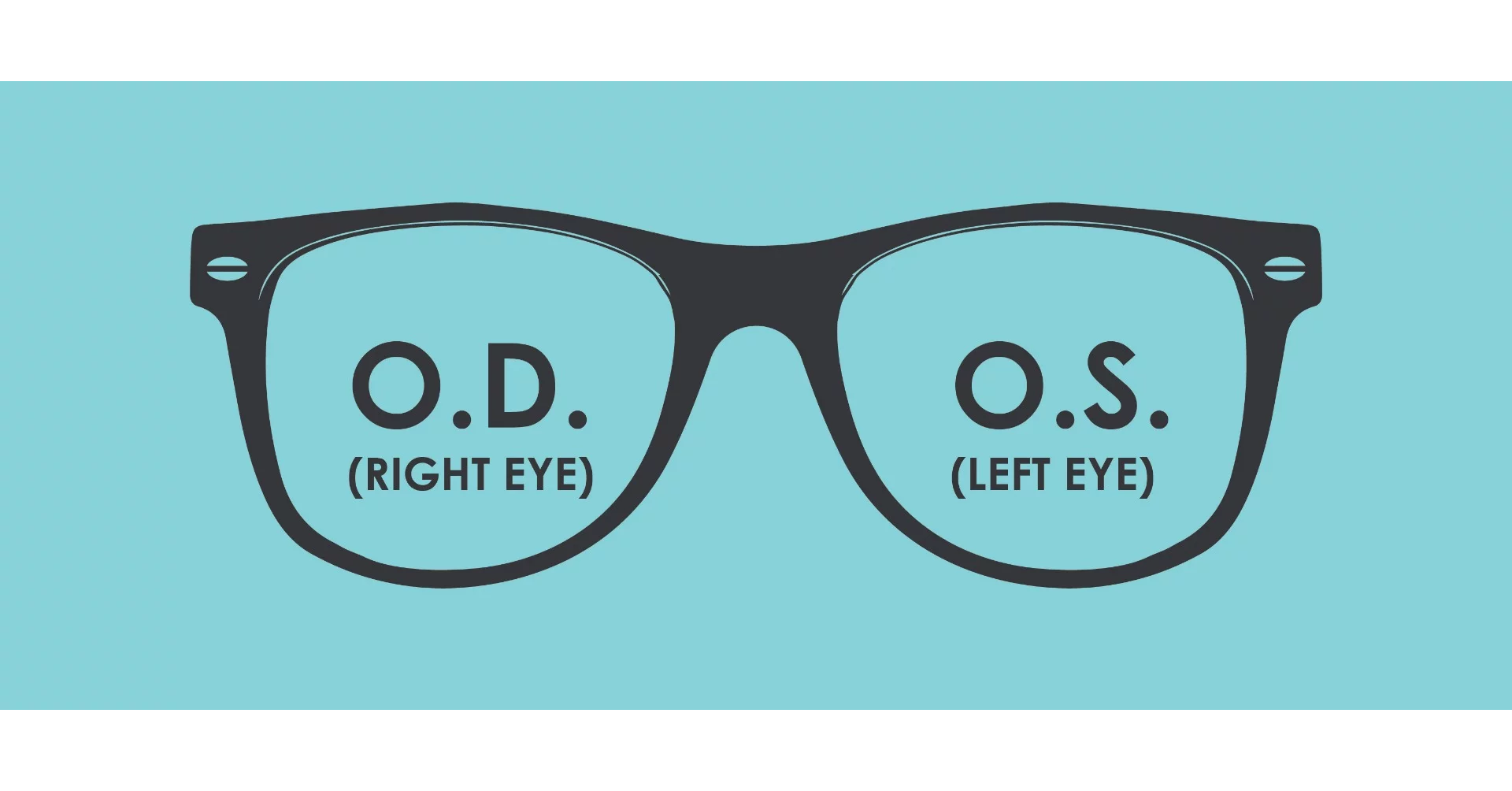
Simply put, “OD” is your right eye and “OS” is your left eye. One memory trick is to think of “D” as referring to your dominant side, which for 85-90% of people in Western countries is the right side. Also the right eye (OD) will always be listed above your left eye (OS).
How to Read an Eye Prescription: What Does Sphere Mean on an Eye Test?
Spherical refractive error determines whether your eyes are nearsighted or farsighted. When your distance vision is blurry, this is known as nearsightedness. This can occur when our eyeballs grow too quickly for an extended period of time during childhood and can continue worsening into our teens and even early adulthood.
Why does it matter? Clear vision is dependent on the size and shape of your eyeball! If your eyes are not symmetrically circular in shape, or too big or too small in size, light is unable to correctly focus on your retina. This results in blurry and distorted vision.
Minus (-) powers means the prescription is nearsighted.
Nearsightedness (myopia) makes far-away objects look blurry.
Plus (+) powers means the prescription is farsighted.
Farsightedness (hyperopia) makes nearby objects look blurry.
How to Read an Eye Prescription: What is Cylinder and Axis?
Both these numbers describe astigmatism. Why is this important?
Astigmatism is a common refractive error that causes your eyes to not clearly focus on images. This can result in blurry vision in the distance and at near. Astigmatism occurs when the eyeball shape is more oval than round. If you are struggling with blurry vision, headaches, glare or eye strain, it is time to get your eyes checked.
Cylinder quantifies the severity of the astigmatism.
Axis is the direction of astigmatism.
How to Read an Eye Prescription for Your Astigmatism Axis
Horizontal (180) Focus
- Writing is blurred at the edges
- It’s more clear in the middle
- It appears as if the letters are moving

Vertical (090) Focus
- Writing is blurred in general
- Nothing is clear
- It appears as if the letters are moving

Curious about treatments and 5 common myths? Our myopia management certified, and award-winning optometrist, Dr. Shaun Pati, debunks the top 5 myths about myopia treatments and recommends 3 treatments.
Do I Need Progressive Lenses? “ADD” on Eye Prescriptions
Your prescription will show a number in the ADD (addition) column if you need progressive lenses, also known as multifocal lenses. This type of prescription means that your optometrist has given you three focus zones in one pair of glasses. It’s incredibly helpful if you have nearsightedness or farsightedness with presbyopia. A progressive lens eliminates the need to switch between glasses when performing close-up work (such as reading a book), intermediate-distance work (like working on a computer), and distance viewing (like driving).
How to Read an Eye Prescription: Is it bad? (What Prescription is Legally Blind)
Legal blindness is a level of blindness that has been defined by law to limit certain activities for safety reasons. These activities include driving, or determining eligibility for disability-related government programs and benefits. Someone is considered to be legally blind when visual acuity is 20/200 or worse in the better eye after correction, and/or a visual field of 20 degrees or narrower.
Learning how to read your eye prescription is important because the higher your prescription is, the worse you will see without correction. In general, without corrective lens use, a -1.00 prescription results in 20/40 acuity, a -3.00 prescription results in 20/160 acuity and a -5.00 prescription results in 20/400 acuity.
How Bad is a +1.00 Eye Prescription?
So a +1.00 and -1.00 refractive error is quite modest; your eyesight isn’t too bad, as you only need 1 diopter of correction. On the other hand, +4.50 and -4.50 represents a greater lack of clarity; you’ll need a stronger prescription to achieve clear vision.

What Does +3.00 Vision Look Like?
Without correction, farsightedness (hyperopia) means distance and near vision can be blurred and this will have a notifiable impact on your vision.

What Does -5.25 Vision Look Like?
Without correction, nearsightedness (myopia) means distance vision is blurry. Your near vision will be clear but you will have to hold objects fairly close to your eyes to see it clearly.

Can Astigmatism Get Worse?
Astigmatism can be genetically passed on or it can be acquired by prolonged near work or excessive eye rubbing. Eyecare professionals can slow or even stop progression if it is caught in time. Astigmatism can get worse over time if left untreated. This is because without treatment, the skewed angle at which light enters your eye worsens, resulting in increasingly blurred and unclear vision.
Contact lenses could be an option for you. Find out if you are suitable for a contact lens fitting.
Real Eyes Optometry
Real Eyes Optometry is centrally located in Metrotown Mall. Our convenient location includes free, accessible parking and the ability for parents to complete errands without driving all over the city.
Consider being able to run to a grocery store, make a clothing return, and grab a quick bite, all while your child is having an eye exam. Of course, accompanying your kid during their eye exam is always a good idea. For details on how to find us, click here.



Disclaimer: This information is for educational purposes and does not replace professional medical advice
FAQ: Optometrist Answers Top Prescription Questions
My script lists an ADD value, does that mean I need to get progressive lenses?
ADD means your eyes need near and intermediate help in addition to distance. Progressives are often the simplest answer, since they give three focus zones in one pair, but our doctors will check your tasks and screen time to see if dedicated computer lenses or reading glasses make more sense.
What makes Real Eyes Optometry a good place to learn how to read my prescription, not just get one?
At Real Eyes Optometry we love to educate our patients especially if they are curious kids. We would love to nerd out and talk about your eye exam and prescription, all you have to do is ask.
I have astigmatism. How do cylinder and axis affect my everyday clarity?
Cylinder is how much, axis is where. Together they correct the oval shape that blurs edges and causes eye strain. We explain your specific axis pattern and match lenses or contacts to reduce glare and headaches, then recheck comfort at pickup
Do you offer pediatric-friendly explanations so my kid understands their script?
Yes. We are a family-run clinic inside Metrotown with pediatric exams and myopia education. Kids and parents get a quick walkthrough of OD, OS, and sphere using simple visuals, and we discuss myopia risks and next steps if progression is a concern.
Can you translate my glasses prescription numbers into safe contact lens choices
We do a dedicated contact lens evaluation. Your glasses script is the starting point, then we verify corneal fit and comfort before ordering. If astigmatism or dryness is in play, we recommend appropriate toric or material options and teach care routines.
How strong is my prescription really, and when is someone considered legally blind?
This page explains practical ranges and what uncorrected vision might look like. To be considered legally blind, we take acuity and visual field into account and not by diopter alone. We put your numbers into context, discuss driving or work needs, and outline options that maximize usable vision

Reviewed by Dr. Amit Sahota, Registered Optometrist (BScOD)