Contact lenses have come a long way from simply being an alternative to glasses. Today, there are types of contact lenses designed around how often you want to wear them, how your eyes focus, the shape of your cornea, and even what you want your contacts to do.
You might want the convenience of daily contact lenses, prefer the routine and value of monthly contact lenses, or need something more specific. Toric contact lenses can correct astigmatism, while multifocal contact lenses can help you see across different distances as your near vision changes with age. There are also specialty options for dry eyes, high prescriptions, irregular corneas, and myopia management.
So how do you know which ones your eyes actually need?
This guide breaks down the different types of contact lenses, why an optometrist might recommend one over another, and some of the contact lens brands and products we recommend for different needs.
Continue exploring: the contact lens guide hub, types of contact lenses, contact lens evaluations, contact lens care, and adult Ortho-K, plus Ortho-K for kids.
Which type of contact lens is right for me?
Start with how often you wear contacts, the vision problem you want to solve, and how your eyes feel during the day. Daily and monthly lenses differ in maintenance, while toric, multifocal, myopia-control, Ortho-K, scleral, RGP, and other specialty designs address more specific visual or fitting needs. An optometrist considers your prescription, eye health, corneal shape, tear film, lifestyle, and budget before recommending a lens.
Types of Contact Lenses at a Glance
There isn’t one contact lens that’s right for everyone. Your prescription is only part of the decision. An optometrist also considers your eye health, corneal shape, tear film, lifestyle, and how often you plan to wear your contacts.
| If you need… | Type of contact lens to consider | Why |
|---|---|---|
| A fresh pair every time you wear contacts | Daily contact lenses | Single-use lenses require no nightly cleaning or storage |
| Contacts you can reuse | Monthly contact lenses | Designed to be cleaned, stored and reused for their prescribed replacement period |
| Vision correction for astigmatism | Toric contact lenses | Designed to keep the corrective powers positioned properly on the eye |
| Distance and near vision in one contact | Multifocal contact lenses | Different lens powers help provide vision across multiple distances |
| Help with dry or uncomfortable eyes | Contacts for dry eyes | Lens material, design and replacement schedule can affect comfort |
| Myopia management for a child | Myopia-control contact lenses | Certain specially designed lenses can help slow myopia progression in children |
| Vision correction while you sleep | Ortho-K lenses | Worn overnight to temporarily reshape the cornea |
| A solution for an irregular cornea or difficult contact lens fit | Scleral or RGP lenses | Specialty designs can provide vision correction when conventional soft lenses aren’t suitable |
| Correction for a particularly high prescription | Extended-range or custom contacts | Available in parameters beyond many standard contact lenses |
| A different eye colour | Coloured contact lenses | Prescription and non-corrective options can alter or enhance eye colour |
Not sure where you fit? That’s normal. Two people with similar prescriptions can end up wearing completely different contact lenses. A contact lens exam and fitting help determine which lens design, material and fit work best for your eyes.
Daily vs. Monthly Contact Lenses: Which Should You Choose?
One of the first decisions when choosing between the different types of contact lenses is how often you want to replace them.
Daily contact lenses are worn once and thrown away at the end of the day. Monthly contact lenses are removed each night, cleaned and stored, then replaced according to their prescribed schedule.
Neither is automatically better. The right choice often comes down to how frequently you wear contacts, how much maintenance you want to do and how your eyes respond to the lens.
Daily or monthly?
If you wear contacts two days a week for sports and social events, a daily disposable may be the obvious choice. If you put contacts in every morning, a monthly lens may be worth considering.
But lifestyle is only half of the equation. During a contact lens fitting, we also look at how the lens sits and moves on your eye, your prescription and how comfortable your eyes remain after several hours of wear.
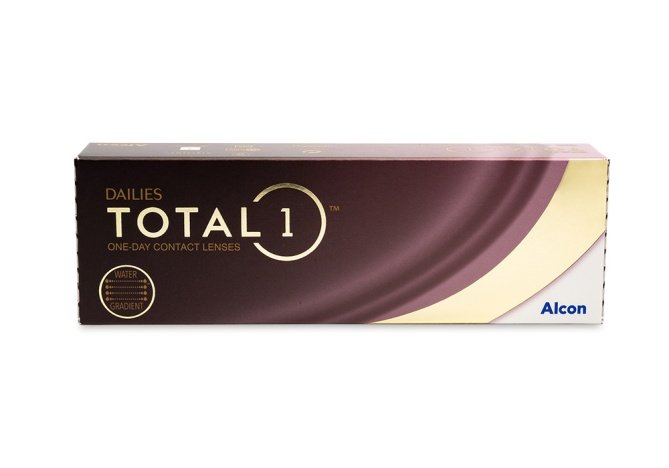
Why Choose Daily Contact Lenses?
If cleaning contact lenses every night sounds like one more chore you don’t need, daily contact lenses are about as simple as it gets. Open a fresh pair in the morning, wear them for the day and dispose of them when you’re finished.
They can be particularly convenient if you only wear contacts occasionally, switch between contacts and glasses, travel frequently or simply prefer starting with a fresh lens each day. There’s also no contact lens case or solution to maintain.
For some people who experience discomfort with reusable lenses, changing to daily contact lenses may also help. That doesn’t mean a daily lens automatically solves dry eye, though. Lens material, fit, tear film and the underlying cause of your symptoms still matter.
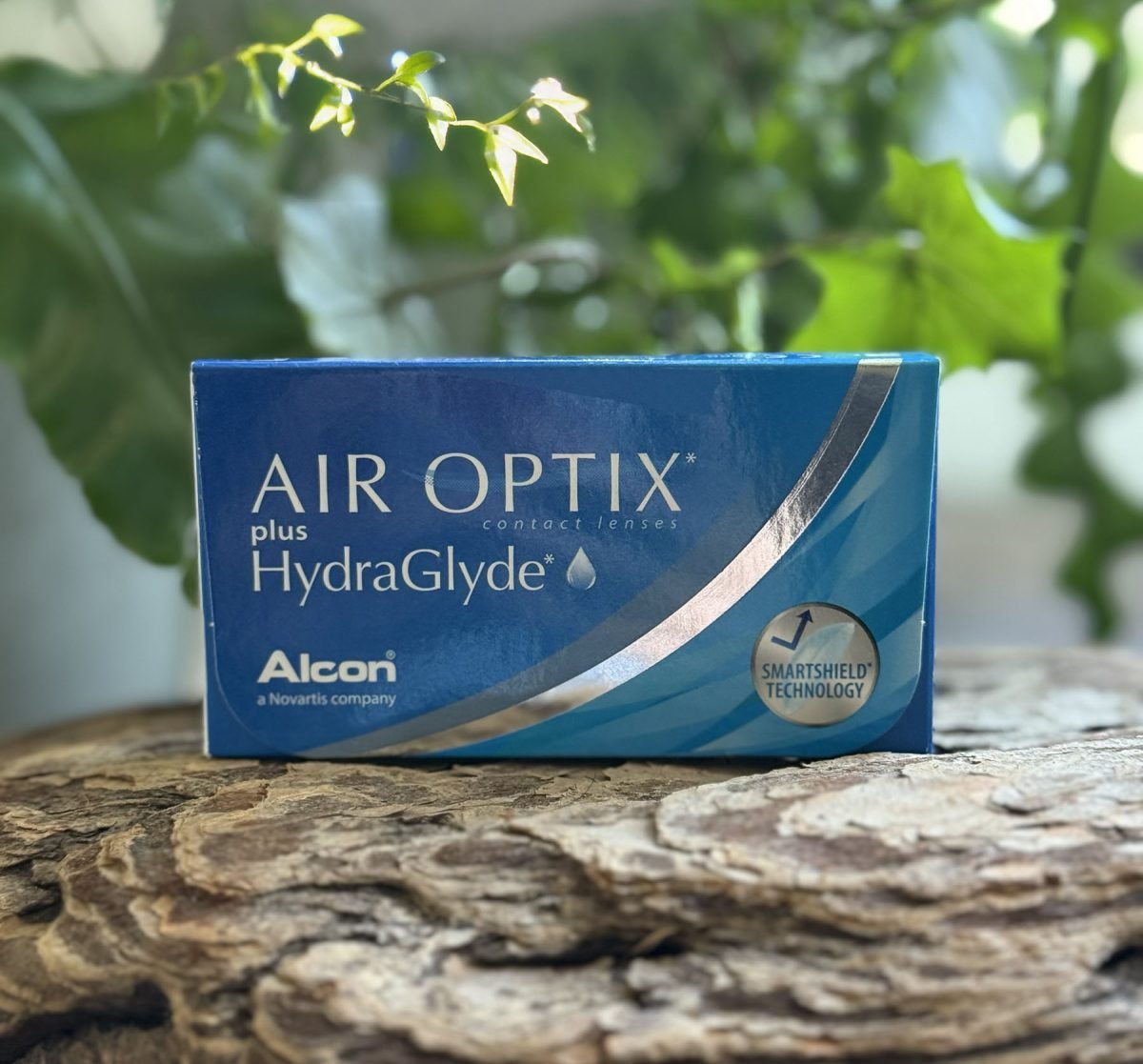
Why Choose Monthly Contact Lenses?
If contacts are part of your everyday routine, monthly contact lenses may make more sense. Instead of opening a new pair each morning, the lenses are cleaned and disinfected after use and replaced on schedule.
They can offer good value for frequent wearers and are available in a wide range of prescriptions and specialty designs.
The trade-off is maintenance. Monthly contact lenses need proper cleaning, handling and storage. Stretching a lens beyond its recommended replacement schedule isn’t a good way to save money. Deposits accumulate on reusable lenses over time and poor contact lens hygiene increases the risk of complications.
Toric Contact Lenses for Astigmatism
If you’ve been told you have astigmatism, you may have also been told at some point that contacts aren’t an option.
For most people, that’s outdated advice.
Toric contact lenses are designed specifically to correct astigmatism. Unlike a standard spherical contact lens, a toric lens contains different corrective powers in different parts of the lens. Its design helps keep those powers properly oriented as you blink and move your eyes.
That’s important because a toric lens that rotates too much can make your vision fluctuate.
Today’s toric contact lenses are available in daily and reusable designs and across increasingly broad prescription ranges. That means someone with astigmatism may still have the choice between daily contact lenses and monthly contact lenses rather than being limited to one specialty option.
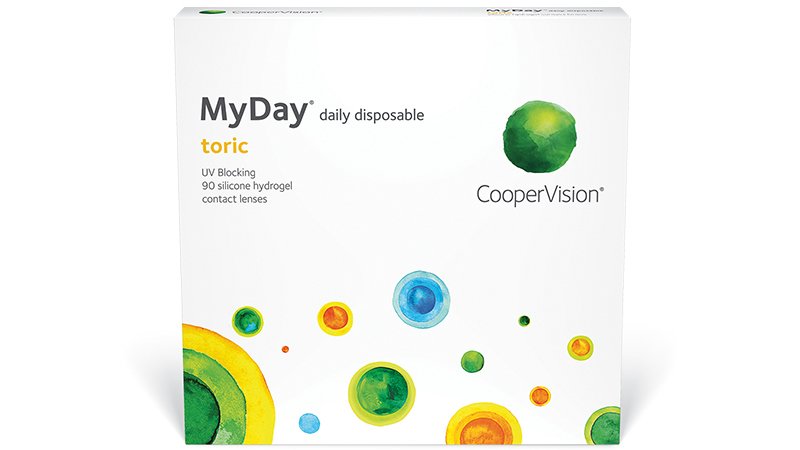
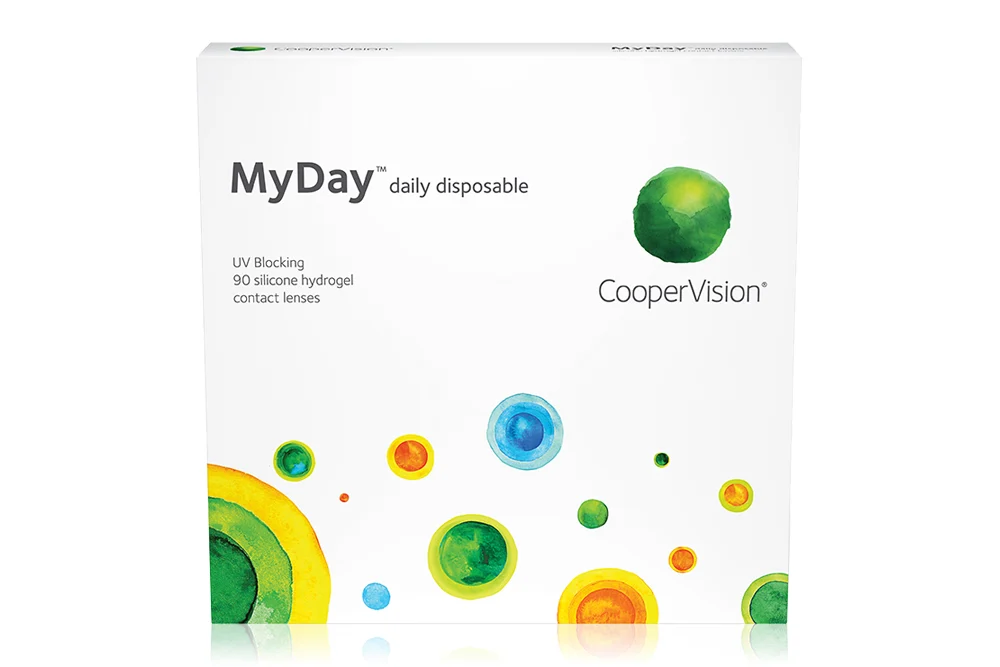
Optometrist Pick: MyDay® toric
One toric contact lens we may consider is CooperVision MyDay toric. It’s a daily disposable, so you get the convenience of a fresh lens every day along with correction specifically designed for astigmatism.
CooperVision offers MyDay toric in an extensive range of prescription parameters and uses its Optimized Toric Lens Geometry to help with lens stability and consistent vision.
Learn more about MyDay toric.
The important word here is may. The contact lens with the most impressive specifications isn’t necessarily the one that will fit your eye best. We still need to see how the lens actually behaves on your eye.
Multifocal Contact Lenses for Reading and Distance
There’s a point when holding your phone a little farther away stops working.
Presbyopia is the gradual loss of the eye’s ability to focus clearly at close distances that occurs with age. It doesn’t mean you have to give up contacts and switch to reading glasses.
Multifocal contact lenses incorporate different focusing powers within the same lens to provide usable vision across near, intermediate, and distance ranges.
Your brain learns to work with the different zones of the lens and select the visual information it needs. That experience can be different from wearing progressive glasses, so getting the prescription and lens design right matters.
Can You Get Multifocal Contacts if You Have Astigmatism?
Yes, in some prescriptions.
Toric multifocal designs combine the astigmatism correction of toric contact lenses with the multiple focusing powers found in multifocal contact lenses.
This is a particularly interesting area of contact lens technology because someone who needs astigmatism correction and reading help no longer necessarily has to choose between the two.
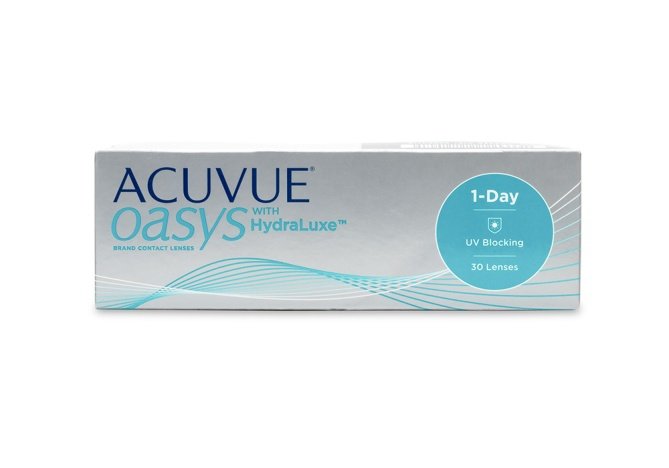
Optometrist Pick: Biofinity® Multifocal
For someone who wants a reusable multifocal, Biofinity multifocal is one option we may consider. It’s a monthly replacement lens designed to provide near, intermediate and distance vision.
CooperVision uses two different optical designs in the Biofinity multifocal fitting system, giving the optometrist more flexibility when balancing near and distance vision for an individual patient.
Learn more about Biofinity multifocal
There are also daily disposable multifocal contact lenses for people who prefer not to clean and store their lenses.
Contact Lenses for Dry Eyes
If your contacts feel great at 8 a.m. and you’re desperate to remove them by 3 p.m., don’t assume you’re simply someone who “can’t wear contacts.”
Dryness and contact lens discomfort can be influenced by your tear film, environment, screen use, blinking, lens material, fit and how long you’ve been wearing the lens.
Changing between different types of contact lenses can sometimes make a significant difference.
For example, some people prefer daily contact lenses because they start with a fresh lens each morning rather than repeatedly cleaning and wearing the same lens. Other people do perfectly well in modern monthly contact lenses.
The important part is figuring out why your contacts are uncomfortable rather than continually buying different brands and hoping one works.
What About “The Best Contacts for Dry Eyes?”
There isn’t one lens we can call the best for every person with dry eyes.
An optometrist may look at your tear film and ocular surface before recommending a different material, replacement schedule or lens design. Sometimes the better solution is treating an underlying dry-eye problem rather than changing contacts again.
For more persistent or complicated dry-eye cases, specialty lenses such as scleral lenses may also be considered.
Scleral Contact Lenses
Some eyes need something very different from a conventional soft contact lens.
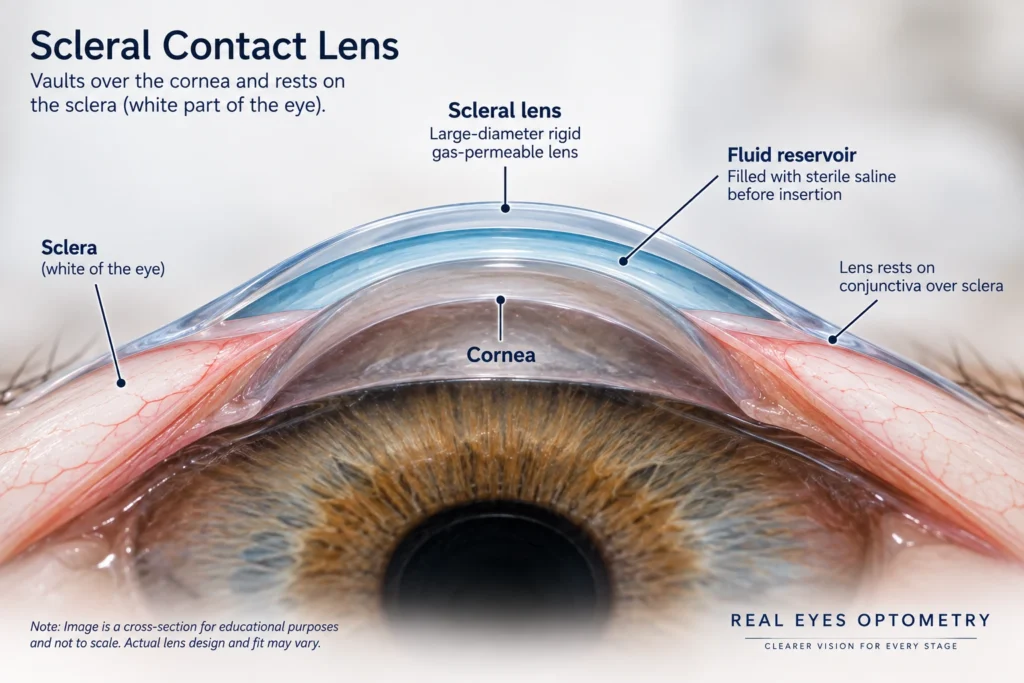
Scleral lenses are large-diameter rigid gas-permeable lenses. Instead of resting primarily on the cornea, they vault over it and rest on the white portion of the eye, called the sclera. The space between the lens and cornea is filled with fluid before the lens is inserted.
That unique design can make scleral lenses useful for certain irregular corneas and difficult contact lens fits, including some people with keratoconus. They may also be used in selected cases involving significant ocular-surface disease.
Scleral lenses require a much more customized fitting process than picking up a box of standard contacts. Measurements are taken to find a lens that properly vaults the cornea and interacts appropriately with the individual eye.
If you’ve tried conventional contacts and repeatedly struggled with vision, fit or comfort, a specialty contact lens assessment may reveal options you didn’t know existed.
RGP and Gas-Permeable Contact Lenses
Rigid gas-permeable lenses, often shortened to RGP lenses, are another specialty option.
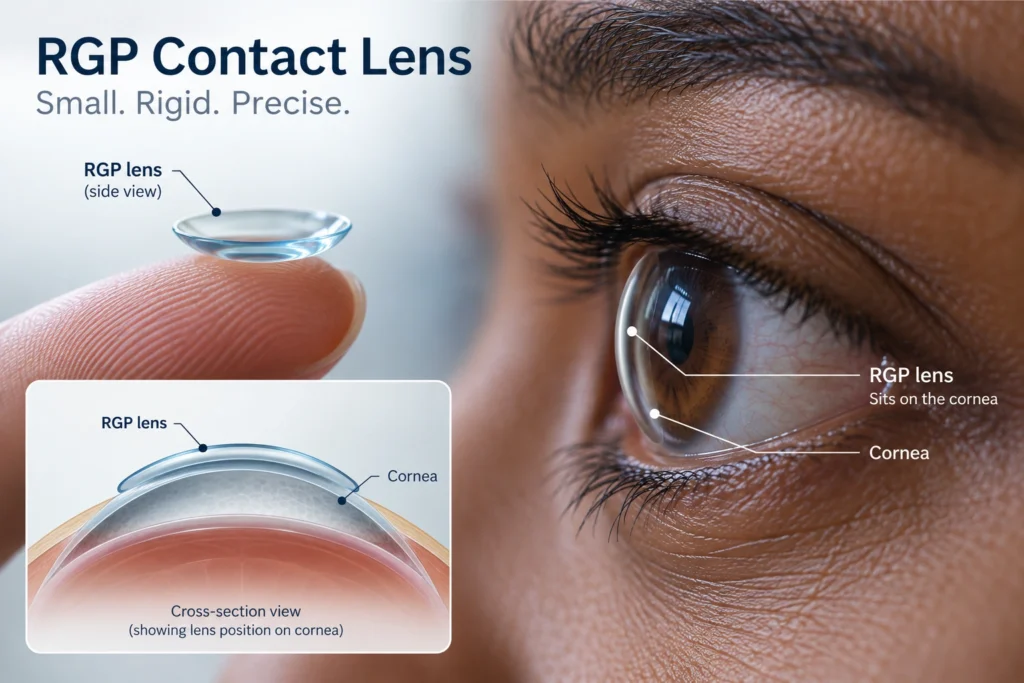
Unlike soft contacts, an RGP lens keeps its shape on the eye. This can produce particularly crisp optics and makes rigid lenses useful for some prescriptions and corneal shapes.
They’re considerably smaller than scleral lenses and sit on the cornea rather than vaulting over it.
The experience is also different from soft contacts. RGP lenses can take more time to adapt to, so they aren’t necessarily the first choice for someone who simply wants occasional contacts for a night out. But for the right eye and prescription, their optical advantages can make them worth considering.
Contact Lenses for Myopia Control
For children with progressing myopia, contact lenses can do more than provide clear vision.
Certain specially designed contact lenses are used for myopia management, with the goal of slowing the progression of nearsightedness as a child’s eyes grow.
This is different from ordinary contact lenses that simply correct blurry distance vision.
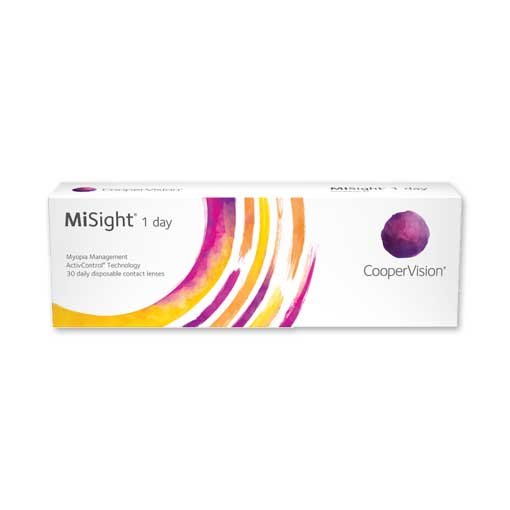
Optometrist Pick: MiSight® 1-day
MiSight 1 day is a daily disposable soft contact lens specifically designed for myopia control in children. CooperVision reports that its ActivControl technology creates treatment zones within the lens while also correcting the child’s distance vision.
Whether a child is ready for contacts depends on more than age. Their prescription, eye health, ability to handle lenses safely, and willingness to follow proper hygiene all matter.

Ortho-K: Contact Lenses You Wear While You Sleep
Ortho-K turns the usual idea of contact lenses around.
Orthokeratology lenses are specially fitted rigid lenses worn overnight. While you sleep, they temporarily reshape the front surface of the cornea. You remove the lenses in the morning and can then see during the day without wearing glasses or contacts.
Ortho-K is also used as a myopia-management option for some children.
Because the effect is temporary, the lenses need to be worn according to the prescribed schedule to maintain the corneal shape and resulting vision correction.
This is very different from simply sleeping in ordinary contacts. You should never sleep in a contact lens unless that specific lens and wearing schedule have been prescribed for you.
Contact Lenses for High Prescriptions
Having a strong prescription doesn’t automatically rule out contact lenses.
Standard disposable lenses are produced within specific prescription and fitting ranges. If your prescription falls outside them, extended-range or custom contact lenses may offer additional options.
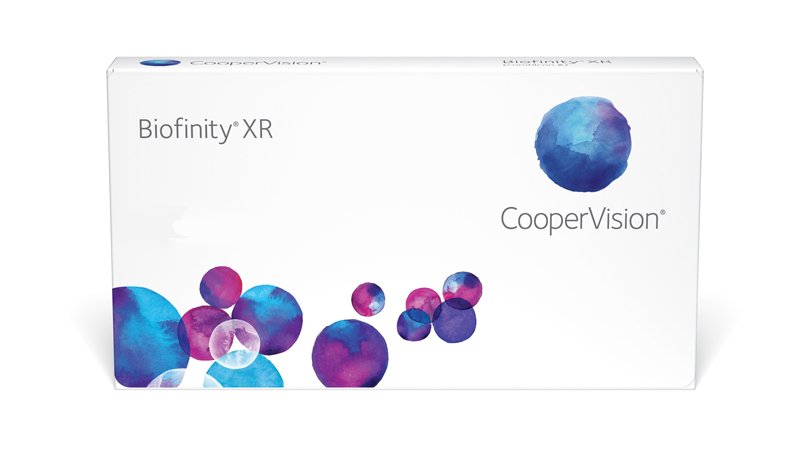
For example, CooperVision’s Biofinity XR family extends the prescription range available in its reusable soft-lens lineup.
Explore Biofinity XR contact lenses
Depending on the prescription, an optometrist might also investigate specialty soft lenses, RGPs or scleral lenses.
So if you’ve been told in the past that your prescription is “too strong for contacts,” it’s worth asking again. Contact lens options continue to evolve.
Colored Contact Lenses
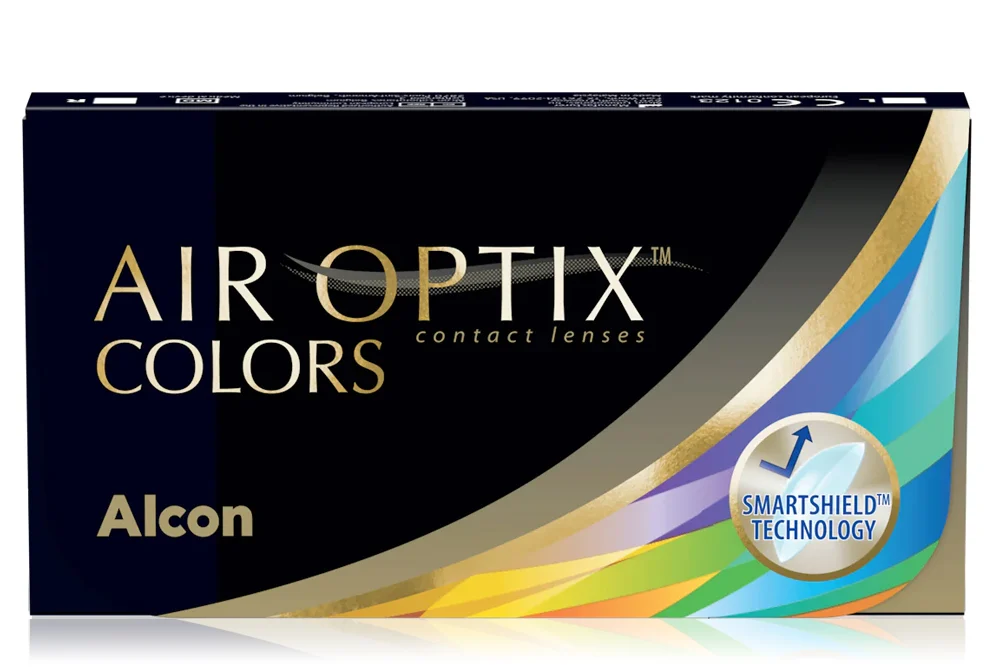
Coloured contact lenses can subtly enhance your natural eye colour or change it much more dramatically.
But they’re still contact lenses.
Even if you don’t need vision correction, a coloured contact lens sits directly on the surface of your eye and needs to fit correctly. Health Canada warns that decorative contact lenses can cause eye injury and infection when they’re used improperly.
That means buying random cosmetic lenses based only on how they look isn’t something we’d recommend.
If you want coloured contacts, an eye exam and contact lens fitting can help determine the appropriate lens parameters and make sure your eyes remain healthy while you’re wearing them.
So, What Are the Best Contact Lenses?
This is probably the question we’d all prefer had a one-box answer.
It doesn’t.
Someone with mild astigmatism who wears contacts twice a week may love daily contact lenses. Someone who wears contacts from morning until night may prefer monthly contact lenses. Another person may need toric contact lenses to keep their vision stable, while someone beginning to struggle with menus and phone screens may be better suited to multifocal contact lenses.
And sometimes the answer isn’t a conventional soft lens at all.
That’s why we think of the different types of contact lenses as a toolbox rather than a ranking. The goal isn’t to find the contact lens with the best marketing claims. It’s to find the lens that gives your eyes the best combination of clear vision, healthy wear and comfort.
How Does an Optometrist Choose Your Contact Lenses?
Your glasses prescription gives us useful information, but it isn’t enough to order contact lenses.
A contact lens fitting considers the shape and health of your eyes, your prescription, tear film, and how the lens actually fits once it’s on your eye. We also want to know what you need the contacts for.
Do you want contacts every day? Just for sports and weekends? Are your current lenses drying out? Do you work at a computer all day? Are you starting to need help reading? Does your astigmatism make your current contacts blur?
Those answers can lead to very different recommendations.
We may start by deciding between daily contact lenses and monthly contact lenses, then determine whether you need a spherical, multifocal or toric contact lens design. For more complex eyes, specialty lenses may open up additional possibilities.
Trial lenses also give us the opportunity to evaluate the fit and let you experience the vision and comfort before settling on a final contact lens prescription.
The result should feel less like choosing a product off a shelf and more like finding a contact lens that was chosen for the way you actually use your eyes.
Frequently Asked Questions About Types of Contact Lenses
Why are my contacts clear in the morning but blurry later in the day?
Several things can cause vision to change throughout the day, including dryness, deposits on the lens, fit and how the contact lens interacts with your tear film. If you have astigmatism, a toric contact lens that rotates on the eye can also cause fluctuating vision. An optometrist can evaluate the lens on your eye rather than simply increasing the prescription.
Can I wear daily contact lenses only on weekends?
Yes. Daily contact lenses can be particularly convenient for occasional wear because you open a fresh pair whenever you need them and don’t have to maintain an opened pair between uses. They can work well for people who normally wear glasses but want contacts for sports, events, travel or certain activities.
I’m starting to need reading glasses. Does that mean I have to stop wearing contacts?
Not necessarily. Multifocal contact lenses are designed to provide vision across more than one distance and can be an option as presbyopia develops. Another approach called monovision uses one eye primarily for distance and the other for near vision. A contact lens fitting can help determine which approach your eyes and brain prefer.
Can I get multifocal contacts if I also have astigmatism?
Potentially. Some types of contact lenses combine multifocal optics with toric correction, allowing the same lens to address presbyopia and astigmatism. Your options depend on your prescription and how the lens fits and performs on your eye.
Why can my friend wear the same contacts comfortably for 12 hours when mine bother me after six?
Because the brand isn’t the whole story. Corneal shape, tear film, prescription, blinking, screen use, environment and lens fit can all influence comfort. Two people can try exactly the same contact lens and have completely different experiences.
I stare at multiple monitors all day. Can my contacts be adjusted specifically for computer work?
Sometimes. Your optometrist may be able to modify the contact lens prescription or, if you wear multifocal contact lenses, adjust the balance between near, intermediate and distance vision. But contact lens discomfort at a computer can also be related to reduced blinking and dry eye, so changing the prescription isn’t always the solution.
If I keep forgetting when I opened my monthly contacts, should I switch to dailies?
It may be worth considering. Monthly contact lenses rely on you replacing them on schedule and cleaning and storing them properly between uses. If remembering replacement dates is consistently difficult, daily contact lenses remove that part of the routine because every pair is discarded after use.
My astigmatism is small. Do I really need toric contact lenses?
Not everyone with a small amount of astigmatism needs a toric design. Some people see well in spherical contacts, while others notice a meaningful improvement with toric contact lenses. Your prescription, visual demands and how sensitive you are to small amounts of blur can influence the decision.
Why can’t I just order contacts using my glasses prescription?
A contact lens sits directly on your eye, while glasses sit in front of it. A contact lens prescription includes information beyond the corrective power, and the lens needs to fit the eye appropriately. This becomes particularly important with toric contact lenses, multifocals and specialty lenses, where positioning can directly affect vision.
What if none of the regular contact lenses seem to fit my eyes?
That’s where specialty contact lenses become interesting. Depending on the reason conventional soft contacts aren’t working, an optometrist may investigate RGP, scleral, custom soft or other specialty types of contact lenses. Sometimes the answer isn’t another brand of standard contacts. It’s a completely different lens design.