Key Takeaways From This Article
- Eyeglass and contact lens prescriptions are not interchangeable.
- Contacts need brand and fit measurements, glasses rely on PD and frame fit.
- Vertex distance changes power in stronger prescriptions, which is why the numbers are often different.
Reviewed by Dr. Amit Sahota, Registered Optometrist (BSc, OD)
July 10, 2026
Sources
American Academy of Ophthalmology aao.org
Vertex Distance, Effective Power, and Compensated Power. nao.org
All About Vision
Are Glasses Prescriptions and Contact Lens Prescriptions the Same?
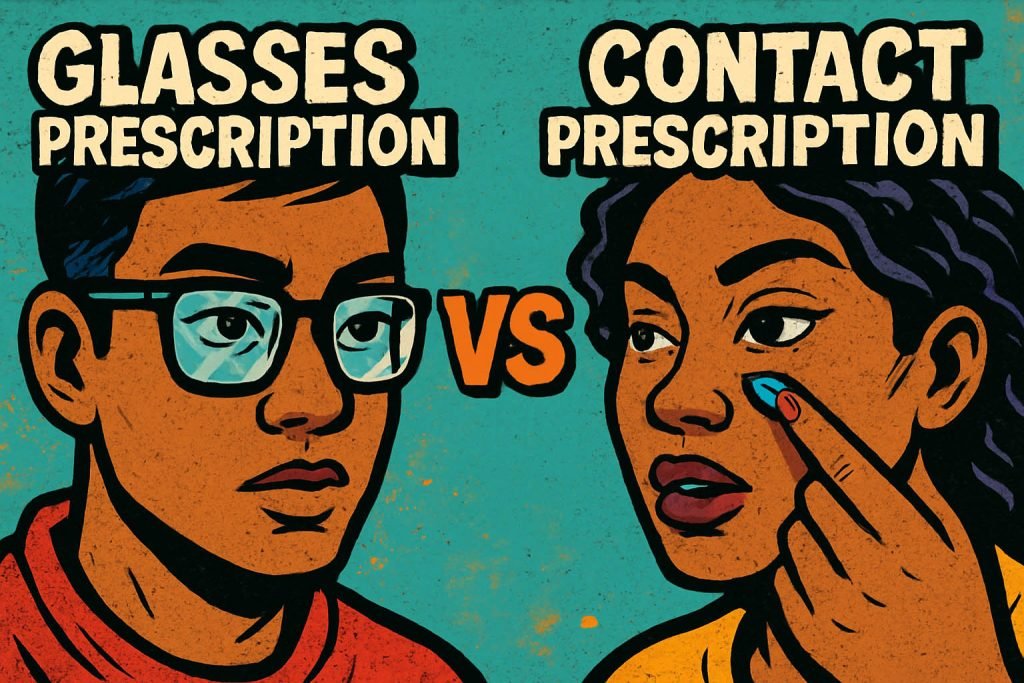
The simple answer is no. Both glasses and contact lenses correct your vision, but you need a separate prescription for each one. If you have a glasses prescription and you are curious why your contact lens numbers look different, you are in the right place. This guide explains what each set of numbers means, why contact lens powers rarely match the spectacles you wear, and how to read both without guesswork.
What is the Big Difference Between My Contact Lens vs Glasses Prescription?
Glasses sit about 12–14 mm in front of the eye while contact lenses sit on the cornea. That shift in distance changes the effective power, which is why higher minus powers tend to step down in contacts and higher plus powers step up. Contacts also need brand and fit details that glasses do not.
How to Read a Glasses Prescription
Your glasses prescription is a recipe that tells the lab how to grind each lens.
- OD and OS identify right and left.
- Sphere (SPH) is the main focusing power. Minus corrects myopia, plus corrects hyperopia.
- Cylinder (CYL) and Axis correct astigmatism. Cylinder is the amount, axis is the direction from 0 to 180 degrees.
- Add is the extra plus power for reading in multifocal and progressive designs.
- Prism shifts images to help the eyes work together.
- PD or pupillary distance aligns optical centers, although many clinics record PD during dispensing rather than in the refraction.
How to Read a Contact Lens Prescription
A contact lens prescription contains some of the same optical data, plus measurements that help a lens fit your cornea and move correctly.
- Brand and material. Contacts are medical devices and are prescribed by brand, not just by power. Contact lenses require a prescription and specific care instructions, which is why brand appears on the Rx itself.
- Base curve (BC). A number like 8.4 or 8.6 that relates to lens curvature and fit.
- Diameter (DIA). Usually 13 to 15 mm for soft lenses.
- Power (SPH) and, for toric lenses, Cylinder and Axis. Toric contacts list cylinder in minus format for soft lenses and include axis just like glasses.
- Add or design name for multifocal contacts.
- Replacement schedule and wearing schedule. Daily disposable, two week, monthly, or approved extended wear.
- Expiration date and the number of refills, which follow prescription laws.
How are the Prescription Numbers Different?
When a lens moves closer or farther from your eye, its effective strength changes. Clinically we correct for that using a vertex conversion for stronger prescriptions. This is a formula that converts the prescriptions. The National Academy of Opticianry teaches that powers stronger than 4.00 diopters in either meridian usually need compensation, and powers of 6.00 or more always do.
Contacts to Glasses Conversion: The Vertex Distance
Example 1 Powerful Prescription:
Imagine a glasses prescription of −6.00 sphere in both eyes. Because contacts sit on the eye rather than 12 to 14 millimetres in front of it, the effective power changes. After using a vertex conversion and rounding to what the brand actually offers, the contact lens might be −5.50 in each eye.
Example 2: Moderate Prescription:
For a moderate prescription like −2.00, the converted number usually stays the same, which is why some people notice no difference between their glasses and contacts while others see a full 0.50 step change.
If your glasses prescription includes cylinder, your fitter decides whether to use a toric contact lens for astigmatism or keep a spherical lens and let the cornea and tear film do some smoothing. Many modern toric lenses are stable and comfortable, so more people can wear their full astigmatic correction in soft lenses than ever before.
For those of you who love numbers, here is the concept. We use the vertex formula to convert power as we change the distance, then round to the nearest step that the contact lens manufacturer makes. You do not need to calculate it at home. Your fitter will do it, then check your vision on the eye.
Vertex Converter: Calculate Glasses Prescription to Contact Lens Prescription
Quick vertex converter
Vertex formula:
Let
F_cl= contact lens power in dioptersF_spec= glasses (spectacle) power at the chosen vertex distanced= vertex distance in meters between glasses and the eye, usually 12 mm →d = 0.012
From contact to glasses: Fspec=Fcl 1+d⋅Fcl F_{\text{spec}} = \frac{F_{\text{cl}}}{\,1 + d \cdot F_{\text{cl}}\,}Fspec=1+d⋅FclFcl
From glasses to contact (the inverse): Fcl=Fspec 1−d⋅Fspec F_{\text{cl}} = \frac{F_{\text{spec}}}{\,1 – d \cdot F_{\text{spec}}\,}Fcl=1−d⋅FspecFspec
Quick examples (d = 0.012 m):
- Contact −9.00 → Glasses −9.00/(1+0.012⋅−9)≈−10.1-9.00 / (1 + 0.012 \cdot -9) \approx -10.1−9.00/(1+0.012⋅−9)≈−10.1
- Contact +9.00 → Glasses 9.00/(1+0.012⋅9)≈+8.19.00 / (1 + 0.012 \cdot 9) \approx +8.19.00/(1+0.012⋅9)≈+8.1
Your Contact Lens Evaluation is Not the Same as a Comprehensive Eye Exam
A routine eye exam checks your vision and ocular health. A contact lens fitting adds measurements of corneal curvature, lid position, tear quality, and how lenses center and move on blinking. A contact lens exam includes a trial fitting and follow up to confirm comfort, clarity, and corneal health.
Contact Lens Prescription vs Glasses Prescription: Side by Side Comparison
Sphere (SPH): The glasses SPH and the contact lens SPH refer to the same type of power. For stronger prescriptions the numbers often differ after vertex conversion. In this example the prescription is mild, so the SPH values match.
Cylinder and Axis: Glasses list CYL and AXIS to correct astigmatism. Toric contact lenses do the same, but soft toric lenses use minus cylinder and are usually available in 0.25 or 0.50 steps, with axis choices in 10-degree steps or finer depending on the brand.
Add power: Progressive glasses show a single numeric Add for near vision. Multifocal contact lenses include an Add value and a design type, such as center-near or center-distance, often labeled Low, Medium, or High.
PD vs BC and DIA: Glasses rely on pupillary distance (PD) to center the lenses in the frame. Contact lenses rely on base curve (BC) and diameter (DIA) to fit the lens to the cornea and eyelids.
Real Examples that Make the Math Easier to Understand
- Example 1: Myopia. Glasses Rx −5.00 sphere both eyes. After conversion, soft contact lens trial at −4.75 gives 20/20 vision.
- Example 2: Hyperopia with astigmatism. Glasses Rx +5.00 −1.50 x 180. That lens moves to the eye, so we vertex each principal meridian. The final toric contact might land near +5.50 −1.25 x 180 depending on brand steps and real world vision.
- Example 3: Progressive wearer. Glasses Rx −2.50 with Add +2.00. Multifocal contact tried at −2.50 with a Medium Add in a center near design to balance distance and reading. The numbers look different because the lens design splits light rather than adding a segment the way glasses do.
When numbers should raise a red flag
- A contact lens prescription that lists no brand, no base curve, or no diameter is incomplete.
- A large jump in power between your glasses and contacts with a low starting prescription may signal a typo, especially if your vision does not match the expected result.
- If you have high astigmatism in glasses and a spherical contact lens was chosen, you should be told why. Many modern toric lenses cover high cylinders well.
- If you have significant anisometropia, the contact lens powers may differ by a different amount than your glasses, since each eye converts separately.
- After cataract surgery or refractive surgery, numbers can change more than expected. A new fitting is normal.
Real Eyes Optometry
Need help sorting out the difference between your contact lens prescription and your glasses numbers? Visit Real Eyes Optometry at Metrotown in Burnaby. With free accessible parking and tons of nearby shops, you can grab groceries, make a return, or get a quick bite while we check your fit and fine-tune your prescription. Parents are welcome to stay during a child’s exam or step out briefly if that is easier. Book a visit and we will walk you through what each number means and set you up with the option that feels best for your eyes.



Disclaimer: This information is for educational purposes and does not replace professional medical advice
Why Branding is on Your Contact Lens Prescription?
In Canada, contact lenses are regulated medical devices, so prescriptions specify brand/material, fit, and expiry. That protects you because oxygen delivery, movement, and surface wetting vary by product.
Which is right for me, contacts or glasses?
Answer a few quick questions. This will not replace an exam, it helps you decide what to try first.
- Do your eyes feel dry for part of most days?
If yes, start with glasses or ask about daily contacts plus dry eye care. If no, go to 2. - How strong is your prescription?
Mild to moderate (roughly within ±3.00): either option works. Higher powers often need extra fit checks and vertex conversion, so book a contact lens fitting. - How many hours a day are you on screens?
6 hours or more: glasses with a computer setup may feel easiest. If you prefer contacts, ask for a near-work contact strategy. - Can you follow a hygiene routine every day?
If yes, contacts are a good match. If no, choose glasses or daily disposables. - What do you want most?
Sports and masks: contacts shine. All-day comfort with zero maintenance: glasses win.
Result: If you leaned glasses on 3 or more answers, start with glasses. If you leaned contacts, book a Contact Lens Evaluation. If it is mixed, try both and decide after a week.
Glasses vs Contact Lenses: Cost Comparison Table
| Topic | Glasses | Contact lenses | Approximate cost (BC) |
|---|---|---|---|
| Exam | Using Glasses requires a Comprehensive eye exam for prescription and ocular health | Eye exam required for Rx, plus contact lens evaluation as needed | Exam: $110–$180. CL fitting add-on: $35–$120 basic, $120–$200 specialty |
| Upfront cost | Frame and lenses | Exam + fitting + initial supply | Frames: $120–$400+. Lenses: single-vision $120–$300, progressives $300–$700+. Initial CL supply: $80–$300 |
| Ongoing cost | Minimal beyond cleanings and occasional adjustments | Replacement lenses on schedule + solutions (if not daily disposables) | Dailies: ~$300–$900/yr depending brand and wear. Monthlies/bi-weeklies: ~$200–$450/yr. Solutions/cases: ~$60–$120/yr |
| Hygiene | Clean lenses and frame as needed | Handwashing every insert/removal, fresh solution, no water exposure | Supplies included above; non-monetary time cost daily |
| Replacement | 1–3 years typical for frame, lenses sooner if Rx changes or lenses scratch | Daily, 2-week, or monthly replacement per box instructions | See “Ongoing cost” ranges |
| Convenience | Instant on and off, no maintenance routine. Can double up function with blue blocker or polarized lense. | Great for sports and masks, needs daily routine | — |
| Risks | Low | Higher infection risk if worn to sleep or exposed to water | Medical visits for complications may be partially covered depending on reason |
| Insurance coverage* | Many extended plans cover glasses on a 24-month cycle | Many extended plans cover contacts annually or bi-annually | Common ranges: $150–$400 for glasses benefits per 24 months; $150–$300 for contacts per 12–24 months (plans vary) |
| Out-of-pocket | Any amount over plan limits, anti-reflective or blue-filter coatings, premium progressives | Fitting fees, supplies, amounts over plan limits, specialty lenses | Varies by plan and choices |
MSP note: MSP generally covers medically required eye care, not routine adult exams between ages 19 and 64. Children and many seniors have broader exam coverage. Contact lens fittings are not covered by MSP.
Seasonal savings: major brands often run mail-in or instant rebates in spring and fall. Contact the clinic directly to find out what offers are available for you!
FAQ About Glasses Lens Prescriptions
Will my contact lens power always be lower than my glasses power if I am nearsighted?
Often yes for moderate and high myopia, because the lens sits on the eye instead of in front of it. The difference depends on strength and fit.
Why do my contact lens boxes not list PD measurements?
PD is not used for contacts. Fit is managed with base curve and diameter, then refined by how the lens centers and moves.
My glasses say prism. Can I still wear contacts?
Sometimes, although it is more complex. Many soft lenses do not provide ground in prism, and the prism in glasses is precise by design. Book an assessment so we can advise case by case.
What if I want the same exact vision in contacts as in my progressive glasses?
Multifocal contacts can work very well, but the optics are different. We balance clarity for distance and near based on your priorities, then test it based on your real life tasks.
Is sleeping in contacts safe if my box says extended wear?
Sleeping in any contact lens increases the risk of eye infections. If you accidentally slept in lenses and your eyes are red or painful, switch to glasses then contact an optometrist.
Eye Exams and Prescription Follow Up
Plan for a contact lens fitting that includes trial lenses, a vision check on the eye, slit lamp evaluation of fit, education on insertion, removal, and care, then a follow up to confirm comfort and corneal health. This extra time protects your eyes and helps us fine tune power and axis.