OCT Eye Test at a Glance
If your optometrist recommends an OCT eye test, it usually means they want a closer look at structures inside your eye, such as the retina, macula, or optic nerve. The scan uses light to create detailed cross-sectional images that can be reviewed alongside your eye exam and other test results.
An OCT may be recommended to investigate something your optometrist noticed, help assess certain eye conditions, or compare changes over time. Being asked to have an OCT does not necessarily mean something is wrong.
On this page, we’ll explain why an OCT may be recommended, what happens during the scan, what your optometrist is looking at and what may happen after your results are reviewed.

Why Did My Optometrist Recommend an OCT?
Sometimes an eye exam gives your optometrist a reason to take a closer look.
They may have noticed something they want to investigate, they may be keeping an eye on a change from a previous visit, or you may have a health or eye condition that makes more detailed imaging useful. An OCT gives your optometrist another piece of information to work with.
Being sent for an OCT doesn’t automatically mean there is a problem. The scan can be used to investigate a concern, establish a baseline for future visits or monitor something that is already known.
The important part is that the OCT isn’t interpreted on its own. Your optometrist looks at the images together with what they found during your eye exam, your symptoms, your health history, and, when needed, other testing.
What Is Your Optometrist Actually Looking At?
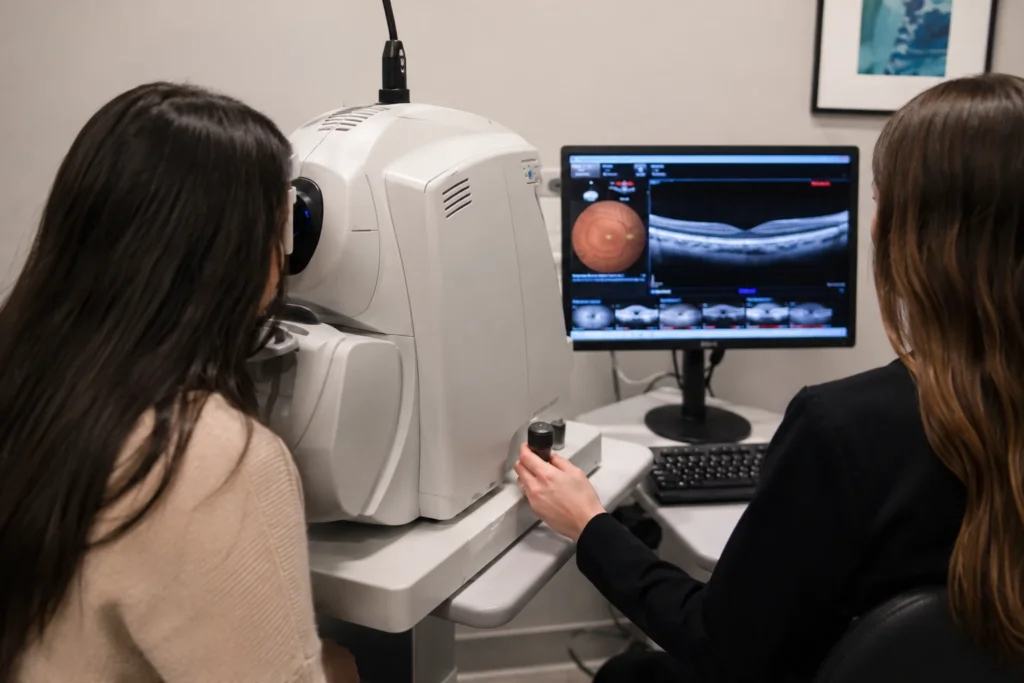
An OCT, short for optical coherence tomography, uses light to create detailed cross-sectional images of structures at the back of your eye. Think of it less like taking a regular photograph and more like being able to see the individual layers within the retina.
Depending on why the scan was recommended, your optometrist may be looking closely at the retina, macula or optic nerve. They can examine the shape and thickness of these structures and look for changes that may not be obvious from vision symptoms alone.
This is also why an OCT can be useful more than once. Sometimes the question isn’t simply “What does the scan look like today?” It’s “Has anything changed since the last one?”
Your optometrist can compare images from different visits and decide whether the findings are stable, need to be monitored or warrant further investigation.
What Happens During an OCT Eye Test?
The scan itself is pretty simple. You’ll sit in front of the OCT machine, rest your chin in position and look toward a target while the machine captures images of your eye.
Nothing touches your eye during the scan. You may see flashes or lines of light as the images are taken, and you’ll need to keep your eye still for a few moments so the machine can get a clear image.
Once the scan is finished, your optometrist can review the images and explain anything that is relevant to your eye health.
Completely non-invasive

Nothing touches your eye

No side effects after testing

What If My OCT Shows Something Unusual?
An unusual OCT result doesn’t automatically give you a diagnosis.
Your optometrist will consider what appears on the scan alongside the rest of your eye exam. Sometimes a finding simply needs to be documented and checked again later. Other times, your optometrist may recommend additional testing or refer you to an ophthalmologist for further assessment.
This is one reason keeping previous OCT scans can be useful. A single scan gives your optometrist a picture from one point in time. Several scans taken over months or years can help show whether something is staying about the same or changing.
Why Would I Need Another OCT Later?
Sometimes the value of an OCT is in the comparison.
If your optometrist is monitoring an area of your retina or optic nerve, a future scan can be compared with the earlier one. This helps show whether the area looks stable or whether something has changed over time.
How often an OCT is repeated depends on why it was recommended in the first place. There isn’t one schedule that makes sense for everyone.
OCT vs. Retinal Photography: What’s the Difference?
They both create images of the back of your eye, but they show your optometrist different things.
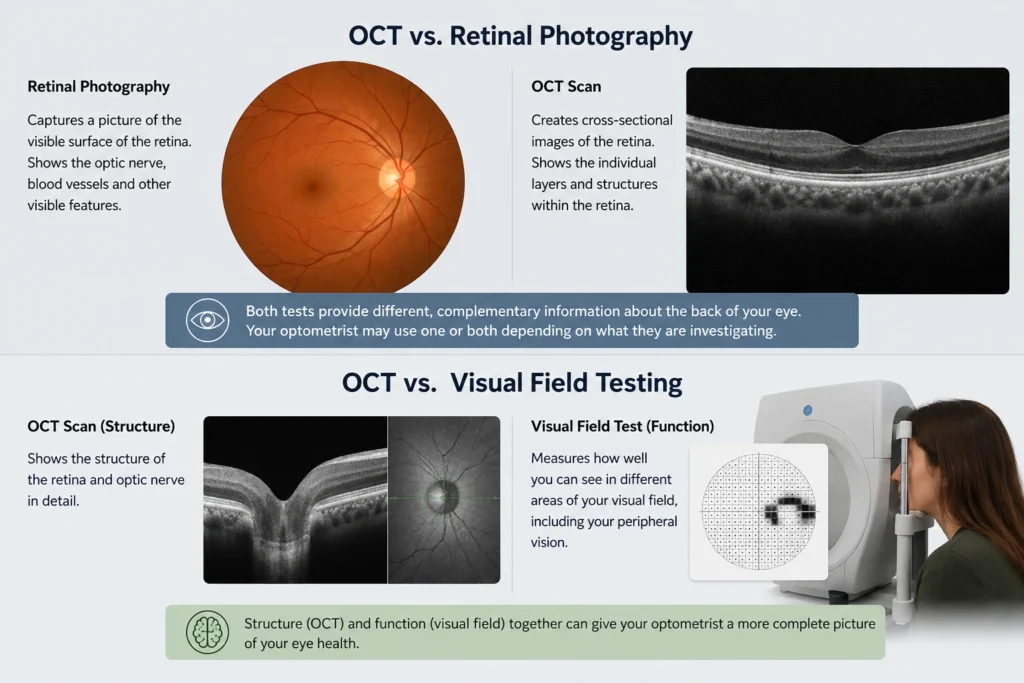
A retinal photograph captures a picture of the visible surface of the retina. It can document things such as the appearance of the optic nerve, blood vessels, and other visible features.
An OCT scan goes a step further by creating cross-sectional images. This lets your optometrist look at the individual layers and structures within the retina.
One doesn’t necessarily replace the other. Depending on what your optometrist is investigating or monitoring, the information from both tests may be useful.
OCT vs. Visual Field Testing: What’s the Difference?
These tests answer different questions.
An OCT scan looks at structure. It creates detailed images of areas such as the retina and optic nerve.
A visual field test looks at function. It measures how well you can see in different areas of your vision, including your peripheral vision.
Your optometrist may recommend one or both depending on what they are investigating. For some conditions, comparing structural information from an OCT with how your vision is functioning can provide a more complete picture.
Do I Need an OCT at Every Eye Exam?
Not necessarily.
An OCT can provide useful information, but that doesn’t mean every patient needs one at every visit. Your optometrist may recommend imaging based on what they see during your eye exam, your symptoms, age, health and family history, or something they are already monitoring.
If an OCT is recommended, you can always ask why your optometrist wants the scan and what they are looking for.
Where Can I Get an OCT Eye Test in Burnaby?
Real Eyes Optometry offers OCT eye imaging at our Metrotown clinic in Burnaby. An OCT may be recommended during your eye care when your optometrist feels that additional imaging would be useful.
If you’ve already been told that you need an OCT, or you have questions about whether one is appropriate for you, let us know when you book your appointment.
Real Eyes Optometry
Real Eyes Optometry is centrally located in Metrotown Mall. Our convenient location includes free, accessible parking and the ability for parents to complete errands without driving all over the city.
Consider being able to run to a grocery store, make a clothing return, and grab a quick bite, all while your child is having an eye exam. Of course, accompanying your kid during their eye exam is always a good idea. For details on how to find us, click here.

Dr. Sahota has a special interest in dry eye care and advanced in-clinic treatments, including radio frequency technology, and is known for providing thorough, personalized dry eye consultations in multiple languages.

Dr. Pati enjoys caring for patients of all ages, with a particular passion for family eye care and pediatric eye health, helping kids build strong visual habits early in life.

Dr. Wang is highly experienced in contact lens fitting, with a special focus on specialty lenses, and has helped many patients who thought they could never wear contacts comfortably.
Disclaimer: This information is for educational purposes and does not replace professional medical advice
OCT Eye Test FAQ’s
My OCT scan showed red or yellow. Does that mean something is wrong?
Not necessarily. OCT software may use colours to compare certain measurements with a reference database, but a colour on the screen is not a diagnosis. Your optometrist interprets the scan in the context of your eyes, your examination and previous imaging.
My last OCT eye test was normal. Why does my optometrist want another one?
Sometimes the comparison is the point. A series of OCT scans can help your optometrist see whether an area has remained stable or changed since your previous visit. A past scan can therefore become more useful when there is another one to compare it with.
Can I have an abnormal OCT eye test but still see perfectly well?
Yes. Changes to structures inside the eye do not always cause obvious changes to vision right away. This is one reason your optometrist considers OCT findings alongside your symptoms and the rest of your eye examination.
Why did my optometrist order an OCT eye test and a visual field test?
They measure different things. An OCT provides information about the structure of areas such as the retina and optic nerve, while a visual field test measures how your vision is functioning across your field of view. Sometimes your optometrist needs both pieces of information.
Should I worry if my optometrist wants to refer me after an OCT eye test?
A referral doesn’t automatically mean a serious eye condition has been diagnosed. It means your optometrist believes a finding would benefit from further assessment by an ophthalmologist or another healthcare provider. The reason for the referral should be explained to you.
Can an OCT eye test tell me if I’m going to develop glaucoma?
An OCT can provide useful information about structures affected by glaucoma, particularly around the optic nerve, but it cannot predict your future or diagnose glaucoma on its own. Your optometrist considers the OCT together with other findings and risk factors.
I have no eye problems. Should I ask for an OCT eye test anyway?
More testing isn’t automatically better. Whether OCT imaging would add useful information depends on your eyes, health history, family history, and findings during your examination. If you’re curious, ask your optometrist whether there is a clinical reason it would be useful for you.
What is the most serious thing an OCT eye test could find?
An OCT can show changes associated with potentially sight-threatening eye diseases such as glaucoma, macular degeneration and diabetes. An OCT finding alone does not confirm a diagnosis. Further testing or a referral may be needed.

Medically Reviewed by Dr. Amit Sahota, Registered Optometrist (BScOD)
Aug 24, 2026