Contact lenses are supposed to make seeing easier, not leave you wondering why one eye is suddenly blurry, why your lens keeps moving, or how something so tiny can be so difficult to get out.
Good contact lens care also depends on what you’re wearing. A soft daily lens behaves differently from a toric, RGP, scleral or Ortho-K lens. Even the way you insert, remove, clean, and troubleshoot them can change.
So instead of giving you one set of instructions for every contact lens, this guide starts with what you’re experiencing. Whether your contacts are blurry, dry, uncomfortable, stuck or simply refusing to cooperate, we’ll help you figure out what may be happening and what to do next.
Continue exploring: the contact lens guide hub, types of contact lenses, contact lens evaluations, contact lens care, and adult Ortho-K, plus Ortho-K for kids.
Which contact lens care advice applies to me?
Start with the type of lens you wear and the problem you are noticing. Soft, toric, multifocal, RGP, scleral, and Ortho-K lenses each need different handling, cleaning, and troubleshooting. If you have pain, significant redness, light sensitivity, discharge, or a sudden change in vision, remove the lens and contact an optometrist.
Contact Lens Care: At a Glance
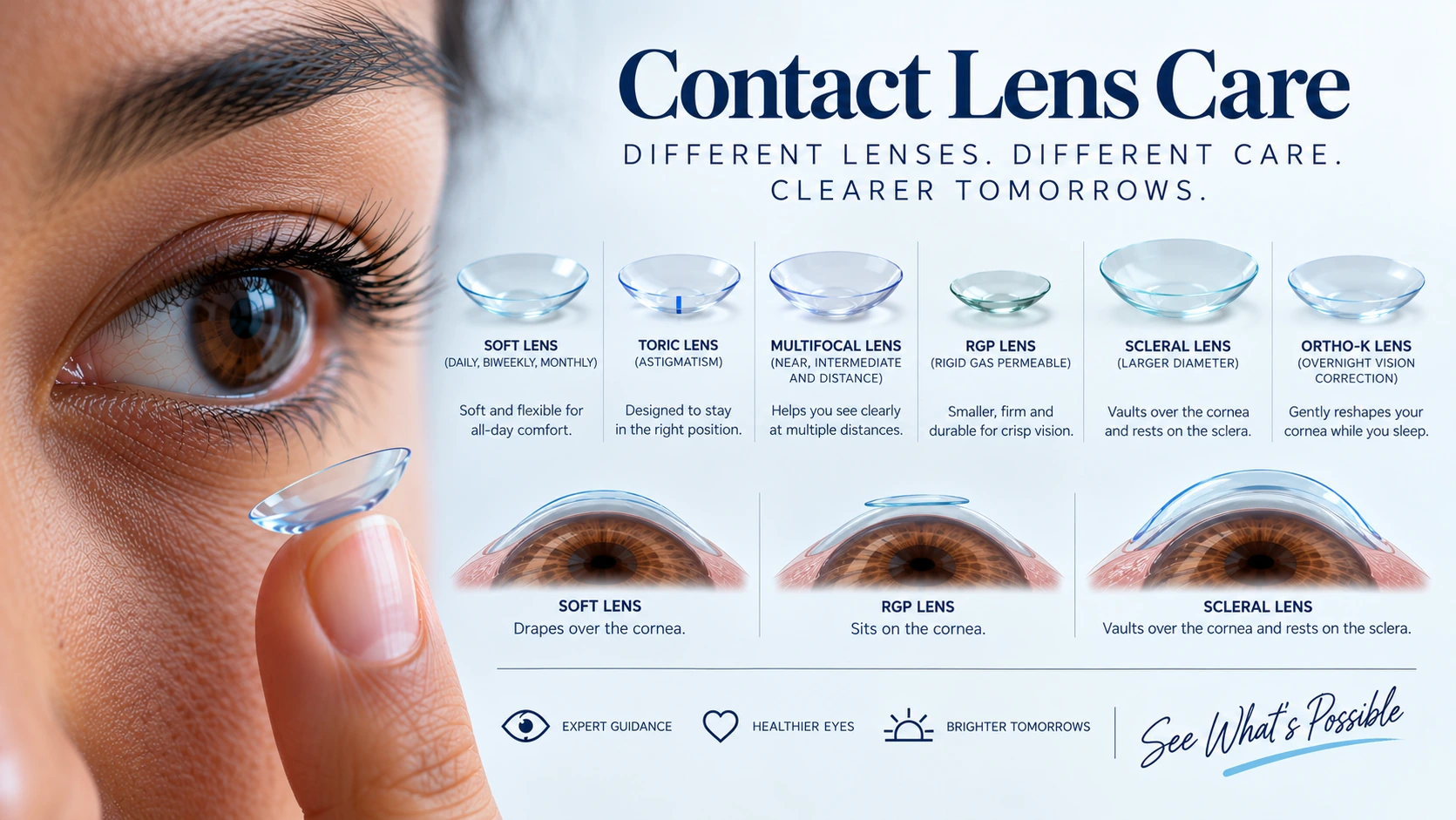
Your contact lenses don’t all play by the same rules. A soft daily lens can usually be pinched out and tossed, while an RGP, scleral or Ortho-K lens needs a different approach. Even blurry vision can mean something different depending on the lens you’re wearing.
Use this guide to start with what’s happening, then find the advice for your type of contact lens.
| Type of contact lens | What makes its care different? | Common problems we’ll cover |
|---|---|---|
| Soft contact lenses | Thin and flexible. Daily lenses are discarded after use, while reusable lenses require cleaning and storage. | Putting them in and taking them out, blurry vision, dryness, discomfort, stuck lenses, and lenses that move or fall out |
| Toric contact lenses | Designed to correct astigmatism and maintain a particular orientation on the eye. | Blurry vision, rotation, shifting lenses, and one eye seeming clearer than the other |
| Multifocal contact lenses | Use different optical designs to provide vision across multiple distances. | Blurry near or distance vision, changing clarity, and adapting to multifocal contacts |
| RGP contact lenses | Smaller, rigid lenses that sit on the cornea and require different insertion, removal, and cleaning techniques than soft contacts. | Getting them in and out, a stuck RGP, lens awareness, movement, debris, and sudden blur |
| Scleral contact lenses | Larger rigid lenses that vault over the cornea and hold a fluid reservoir beneath the lens. | Insertion and removal, air bubbles, fogging, blurry vision, discomfort, and a stuck scleral lens |
| Ortho-K lenses | Specially designed rigid lenses worn overnight to temporarily reshape the cornea. | Bedtime insertion, morning removal, blurry morning vision, halos, lens positioning, and cleaning |
Not sure what kind of contacts you wear? Start with our Types of Contact Lenses guide to identify the differences between daily, monthly, toric, multifocal, RGP, scleral, and Ortho-K lenses.
Soft Contact Lens Care

Soft contact lenses are where many people start. They’re thin, flexible, and designed to drape over the cornea, but “soft contacts” covers everything from daily disposables to lenses you clean and reuse for several weeks.
That distinction matters for contact lens care. If something goes wrong with a daily disposable, the answer may simply be to throw it away and start with a fresh lens. With two-week or monthly contacts, cleaning, storage, and the condition of the lens become part of the troubleshooting.
How to Put In Soft Contact Lenses
Start with clean, completely dry hands. Place the contact on the tip of your finger and look at it from the side. It should form a smooth cup with the edges pointing upward. If the edges flare outward, the lens may be inside out.
Hold your upper eyelid so you can’t blink, pull down the lower lid with your other hand and gently place the lens on your eye. Release your eyelids slowly and blink a few times to let the contact settle.
If the lens immediately feels scratchy or your vision is blurry, don’t keep blinking and hoping it sorts itself out. Remove it and check for an inside-out lens, a tear, debris, or anything else that looks unusual.
How to Remove Soft Contact Lenses
Look slightly upward and use a clean, dry fingertip to gently slide the lens toward the white part of your eye. Once it’s off the centre of the cornea, gently pinch the lens between the pads of your thumb and index finger to remove it.
If you wear daily contacts, discard the lens after use. If you wear reusable contacts, clean, disinfect and store them using the lens-care system recommended for your particular lenses.
Why Are My Soft Contacts Blurry?
Before assuming your prescription has changed, look at when the blur happens.
If a contact is blurry immediately after insertion, it could be inside out, damaged, dirty or not centred properly. If your vision starts clear and becomes blurry later in the day, dryness, deposits, or changes in your tear film may be contributing.
Try removing the lens and inspecting it. Daily lens wearer? Starting again with a fresh contact is an easy way to rule out a damaged or dirty lens.
If blurry contacts keep happening with fresh lenses, especially in the same eye, it’s worth having the prescription and fit checked rather than repeatedly replacing the lens.
Why Do My Soft Contacts Feel Dry or Uncomfortable?
Contacts that feel great at breakfast can feel very different after hours of screens, indoor heating, or air conditioning.
You may also notice discomfort when a reusable lens is nearing replacement, when deposits have accumulated on its surface, or when your eyes aren’t producing a stable enough tear film to keep the lens comfortable.
Compatible lubricating eye drops may help in some situations, but recurring dryness shouldn’t automatically be treated as something contact lens wearers have to tolerate. Sometimes changing the lens material, design, or replacement schedule can make a considerable difference.
My Soft Contact Is Stuck in My Eye
First, don’t panic and don’t start digging at your eye.
A soft lens can become difficult to remove when the eye or lens becomes dry. It can also fold or move underneath an eyelid, which can make it feel as though the contact has disappeared.
A contact lens cannot travel behind your eyeball. The anatomy around your eye prevents that from happening.
If the lens is centered but feels stuck, blink several times and use compatible lubricating drops if recommended for your lenses. Give the lens a chance to move freely again before attempting your usual removal technique.
If you still can’t remove the contact lens, or your eye becomes painful, very red or increasingly irritated, stop repeatedly trying to remove it and contact your optometrist.
Why Does My Soft Contact Keep Moving or Falling Out?
Soft contacts should move slightly when you blink, but they shouldn’t regularly slide away from the centre of your eye or fall out.
Occasional movement can happen if your eye is particularly dry or the lens hasn’t settled properly. Repeated movement can also point to a lens that isn’t fitting your eye as intended.
If the same thing happens again and again, that’s useful information for your optometrist. Contact lenses come in different designs, diameters, and curves, and another lens may sit more predictably on your eye.
Toric Contact Lens Care

Most toric contact lenses are handled much like other soft contacts, so you don’t need to learn an entirely new way to put them in or take them out.
What is different is what happens once the lens reaches your eye.
Toric contacts correct astigmatism, which means the lens needs to maintain the intended orientation for your prescription to work properly. Manufacturers use different stabilization designs to help the lens settle into position after you blink.
That’s why one of the biggest clues that something isn’t quite right with a toric lens is vision that changes as the lens moves.
Why Are My Toric Contacts Blurry?
If you put in a toric contact and everything looks slightly fuzzy for the first few moments, give the lens a chance to settle.
But pay attention to what happens next.
If your vision goes clear → blurry → clear again, particularly after blinking or moving your eyes, the lens may be rotating and then returning toward its intended position.
Persistent blur can have other causes too, including dryness, debris, a damaged lens or a prescription that needs reassessment.
Why Does My Toric Contact Keep Rotating?
A toric lens isn’t expected to remain completely motionless. It should move naturally with blinking while its stabilization design helps it return to the intended orientation.
The problem is excessive or inconsistent rotation.
If the lens rotates too much, doesn’t return reliably or settles in a position that doesn’t work well with your prescription, your vision can fluctuate.
That’s not necessarily a contact lens care problem you can fix at home. Your optometrist can evaluate how the lens actually moves on your eye and determine whether another fit, design or prescription adjustment would provide more stable vision.
Why Is One Toric Contact Clearer Than the Other?
Your two eyes aren’t necessarily identical.
They can have different prescriptions, amounts or orientations of astigmatism, tear films and even slightly different lens fits. That means one toric contact may settle beautifully while the other is more temperamental.
If one eye is consistently blurry with a fresh contact, don’t compensate by simply relying on the clearer eye. It’s worth having that lens checked.
What’s the Little Line on My Toric Contact?
You may notice a tiny line or marking near the edge of some toric contact lenses.
It isn’t damage.
These orientation markings help eye-care professionals assess how a toric lens is sitting and rotating on the eye. They aren’t something you generally need to line up manually before inserting your contact.
If your toric lenses regularly rotate, shift or give you fluctuating vision, that little mark can actually help your optometrist figure out what’s happening.
Multifocal Contact Lens Care

Multifocal contact lenses are a little different because blurry vision doesn’t always mean something is wrong with the lens.
These contacts are designed to provide vision at more than one distance. Depending on the design, different areas or optical powers within the lens contribute to near, intermediate, and distance vision. Your visual system has to learn how to use that information together.
So if you’re new to multifocals and wondering why the restaurant menu looks great, but the tiny street sign across the road doesn’t, the answer may be different from someone whose previously clear multifocal suddenly becomes blurry.
Why Are My Multifocal Contacts Blurry?
Start with what is blurry and when.
If everything is blurry immediately after putting the lens in, check the same things you would with other soft contacts: Is the lens inside out? Is there debris on it? Is your eye particularly dry? Is the lens damaged?
If the contact itself seems fine but certain distances aren’t as sharp as you’d like, the multifocal design may be part of the equation.
You might notice:
- distance is clear, but reading is difficult,
- reading is clear, but distance feels slightly soft,
- Your computer falls into an awkward middle zone
- vision changes in different lighting, or
- one eye seems to perform differently from the other.
A multifocal fitting is often about finding the right balance, rather than simply making every part of the prescription stronger.
Why Are My Multifocal Contacts Blurry at Certain Distances?
This is where multifocal contacts can take some getting used to.
Unlike single-vision contacts, they have to provide useful vision across several distances. The exact optical design varies between lenses, and your two eyes may not necessarily be prescribed exactly the same way.
Pay attention to where your vision is struggling.
If your phone is clear but your computer isn’t, tell your optometrist. If night driving is the problem but daytime distance vision is good, that’s useful information too.
“Multifocal contacts are blurry” doesn’t tell us nearly as much as “my laptop gets blurry after an hour, but my distance vision is fine.”
Those details can help your optometrist fine-tune the prescription or try a different multifocal design.
Do Multifocal Contacts Take Time to Adjust To?
They can.
Your brain needs time to adapt to the visual information provided by multifocal lenses, particularly if this is your first time using a multifocal correction.
That doesn’t mean every problem should be dismissed as “you just need to get used to them.”
If your vision isn’t improving, one distance is consistently difficult, or the lenses are interfering with things you need to do every day, let your optometrist know. Sometimes a small prescription adjustment or different lens design works better than simply waiting longer.
Why Do My Multifocal Contacts Work Better in Certain Lighting?
You may notice that reading or distance vision changes when you move from bright daylight into a dim restaurant or drive at night.
Your pupil changes size with lighting, which can affect how your eye interacts with the different optical zones of some multifocal designs. Contrast is also reduced in lower-light conditions.
That makes knowing when and where the blur happens particularly useful information during a multifocal contact lens follow-up.
Instead of saying, “They’re kind of blurry,” try remembering the situation.
Computer at work? Menu in a dark restaurant? Driving at night? Tiny text on your phone?
Those details are much more helpful.
Real Eyes Optometry
Real Eyes Optometry is centrally located in Metrotown Mall. Our convenient location includes free, accessible parking and the ability for parents to complete errands without driving all over the city.
Consider being able to run to a grocery store, make a clothing return, and grab a quick bite, all while your child is having an eye exam. Of course, accompanying your kid during their eye exam is always a good idea. For details on how to find us, click here.



RGP Contact Lens Care
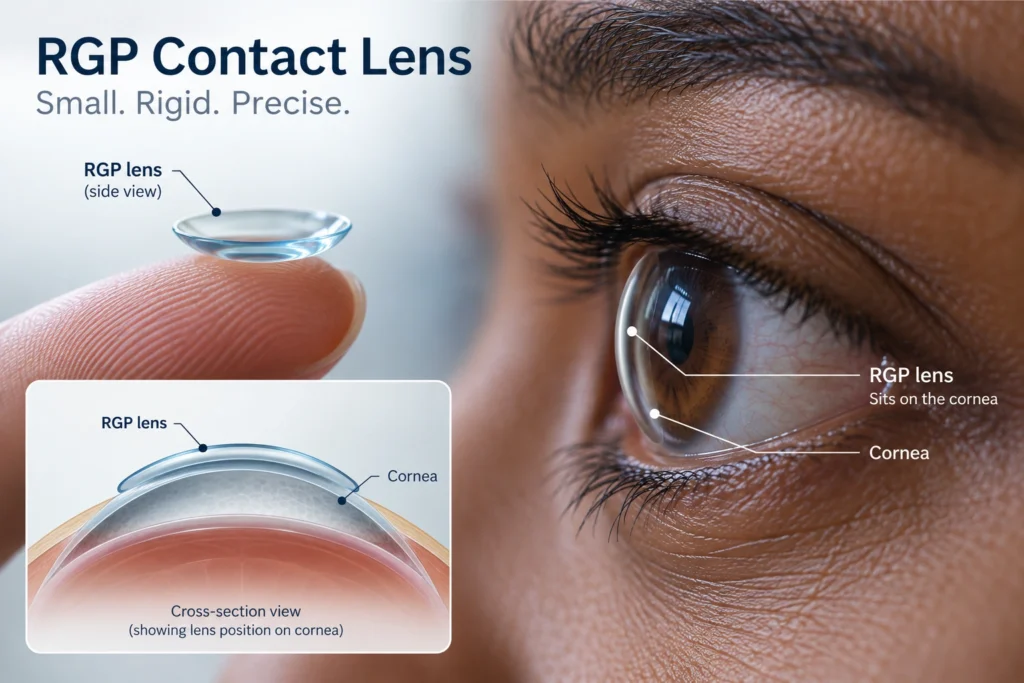
Rigid gas-permeable lenses, or RGP contact lenses, are considerably smaller than soft contacts and keep their shape on the eye. They sit over the cornea rather than draping across it like a soft lens.
That changes almost everything about handling them.
If you’ve spent years pinching out soft contacts, don’t automatically use the same technique with an RGP. How you put in, remove, clean and troubleshoot a rigid lens is different.
How to Put In RGP Contact Lenses
Wash and thoroughly dry your hands before handling the lens. Place the RGP on the tip of your finger and inspect it for debris, damage or anything unusual before insertion.
Hold your eyelids securely and gently place the lens onto the centre of your cornea using the insertion technique your optometrist showed you.
Because an RGP is small and rigid, positioning matters more than it does with a large, flexible soft lens.
If it lands off-centre, don’t repeatedly poke at the lens trying to push it into position. Follow the repositioning technique you’ve been taught, or remove it and start again.
How to Remove RGP Contact Lenses
This is one of the biggest differences from soft contacts.
Depending on the lens and what your optometrist has taught you, an RGP may be removed using an eyelid technique or an appropriate removal tool. It generally isn’t removed using the same pinch technique used for a soft contact.
Because techniques can vary, use the removal method prescribed for your particular lenses rather than improvising.
Why Can I Feel My RGP Lens When I Blink?
If you’re switching from soft contacts to RGP lenses, being more aware of the lens at first isn’t unusual.
An RGP is rigid and smaller than a soft contact. Your eyelid moves over its edge when you blink, so the initial sensation can be quite different.
Comfort should generally improve as you adapt.
What deserves more attention is a lens that suddenly becomes uncomfortable after previously feeling fine.
A piece of debris underneath the lens, deposits, dryness, damage, or a change in how the lens is sitting can all contribute.
Why Is My RGP Contact Blurry?
RGP lenses can provide very crisp optics, which also means you’ll probably notice when something interferes with them.
Sudden blur may happen if:
- The lens moves away from its intended position,
- Debris gets underneath it
- Deposits build up on its surface
- The lens becomes poorly wetted, or
- The fit or prescription needs reassessment.
If the blur disappears when the lens recentres or after it has been properly cleaned, that gives you a clue about what happened.
Repeated blur deserves a closer look.
Why Does My RGP Lens Move Around?
RGP contacts are expected to have some movement with blinking. That movement helps tears circulate beneath the lens.
But there’s a difference between normal movement and a lens that seems to wander around your eye.
Too much movement, frequent decentration, or a lens that repeatedly dislodges may indicate that the fit needs to be evaluated.
This isn’t something you should try to fix by changing how you insert the lens. An optometrist can watch how the RGP moves with each blink and determine whether its fit is appropriate.
My RGP Lens Is Stuck. What Should I Do?
If an RGP isn’t coming out normally, avoid repeatedly grabbing or scraping at your eye.
First, identify where the lens is. A small rigid lens can move away from the centre of the cornea and end up beneath an eyelid, which can make it seem as though the contact has disappeared.
It cannot travel behind your eyeball.
If you can see the lens but your normal removal method isn’t working, stop after reasonable attempts rather than escalating to more aggressive techniques.
A contact lens that remains stuck, particularly with increasing pain, redness, or irritation, is a good reason to contact your optometrist.
How Do You Clean RGP Contact Lenses?
Unlike daily disposable soft contacts, RGP lenses are designed to be cleaned, disinfected and reused.
Use the cleaning and storage system recommended for your particular lenses. Products intended for soft contacts aren’t automatically interchangeable with products used for rigid lenses.
And no matter how tempting the shortcut might seem, water isn’t contact lens solution.
If you’re unsure which bottle goes with your RGP lenses, check before experimenting. With specialty contacts, the care system is part of the prescription, not an afterthought.

Scleral Contact Lens Care
Scleral contact lens care is quite different from caring for a typical soft contact. Scleral lenses are larger rigid lenses that vault over the cornea and rest on the sclera, with a fluid reservoir between the lens and the cornea.
That design is what makes scleral contacts useful for certain irregular corneas and ocular surface conditions, but it also creates some very specific troubleshooting questions. If you wear scleral lenses, knowing how to put in contact lenses and remove them correctly is particularly important because bubbles, inadequate filling, fogging and removal technique can all affect how the lens feels and how well you see.
How to Put In Scleral Contact Lenses
Scleral lenses are filled before they go onto the eye. This is one of the biggest differences between scleral contact lens care and handling a regular soft contact.
Wash and completely dry your hands. Place the scleral lens on the insertion device or use the manual technique your optometrist has taught you. Fill the lens completely with the recommended preservative-free filling solution.
Then lean forward so your face is parallel to the floor, hold your eyelids wide open and bring the filled lens straight toward your eye.
The goal is to get the lens onto the eye without losing fluid or trapping an air bubble underneath it.
After insertion, look closely for bubbles. If you see one, the lens will generally need to be removed, refilled and inserted again.
Why Are There Bubbles Under My Scleral Lens?
Bubbles usually get trapped during insertion.
Maybe the lens wasn’t completely filled. Maybe some fluid spilled as you brought it toward your eye. Or maybe you blinked just as the lens was being inserted.
A bubble isn’t something you should simply ignore. It can interfere with vision and may cause localized discomfort.
Remove the lens, refill it completely, and try again.
If you’re getting bubbles almost every time you insert your scleral contacts, ask your optometrist to watch your technique. Sometimes a surprisingly small change in head position, eyelid control, or how you hold the lens makes insertion much easier.
Why Are My Scleral Contacts Blurry?
If you’re wondering why your contacts are blurry, timing gives us an important clue with scleral lenses.
Blurry immediately after insertion?
Look for a bubble, debris, or a problem with the fluid reservoir.
Clear when inserted, blurry several hours later?
That sounds more like scleral lens fogging.
Scleral lenses create a fluid reservoir over the cornea. Over time, debris can sometimes accumulate within that space and make vision look hazy or foggy.
Repeated fogging is worth discussing at your contact lens appointment. Your optometrist can evaluate the lens fit, ocular surface, and care routine rather than having you repeatedly remove and reinsert the lens throughout the day.
How to Remove Scleral Contact Lenses
Learning how to remove contact lenses becomes especially lens-specific here.
You don’t remove a scleral lens using the same pinch technique you would use for a soft contact.
Follow the removal method your optometrist taught you. When a removal plunger is used, it is generally positioned toward the edge of the lens rather than directly in the centre so the seal can be released.
Once removed, reusable scleral lenses need to be cleaned and disinfected using the system prescribed for them.
My Scleral Contact Is Stuck in My Eye
A contact stuck in the eye feels particularly intimidating when it’s a large rigid scleral lens.
Don’t pull harder.
The lens first needs to have its seal released. Follow the removal technique you were taught rather than repeatedly tugging at the centre of the lens.
If your usual method isn’t working, your eye is becoming increasingly irritated, or you’re experiencing significant pain, stop and contact your optometrist.
How Do You Clean Scleral Contact Lenses?
One potentially confusing part of scleral contact lens care is that the liquid used to fill the lens isn’t necessarily the same product used to clean and disinfect it.
Follow the cleaning, disinfecting, rinsing, and storage routine prescribed for your particular lenses and care system.
Don’t substitute tap water because you’re out of solution. Water exposure is something contact lens wearers should avoid.

Ortho-K Contact Lens Care
Ortho-K turns one of the most familiar pieces of contact lens care advice on its head: these contacts are actually designed to be worn while you sleep.
Orthokeratology lenses are specially designed rigid gas-permeable lenses that temporarily reshape the cornea overnight. You remove them in the morning and go through the day without wearing the lenses.
That means Ortho-K problems can show up differently too. Instead of asking,
“Why are my contacts blurry while I’m wearing them?”
You may wake up, remove your lenses, and wonder why your vision is blurry afterward.

How to Put In Ortho-K Contact Lenses
Wash and thoroughly dry your hands before handling your Ortho-K lenses.
Inspect the lens for debris, deposits, or damage before insertion. Then follow the insertion technique your optometrist has demonstrated for your particular lenses.
Because Ortho-K treatment depends on how the lens positions on the cornea overnight, don’t treat a lens that repeatedly feels or looks off-centre as something you simply need to get better at tolerating.
Tell your optometrist.
How to Remove Ortho-K Contact Lenses
How to remove contact lenses is particularly important with Ortho-K because the lens may feel different when you wake up than it did when you went to bed.
Follow the morning removal technique provided by your optometrist. Don’t force a lens that doesn’t seem ready to move.
If an Ortho-K contact is stuck in your eye, avoid repeatedly pulling or scraping at it. Follow your prescribed removal procedure, and if the lens remains difficult to remove or the eye becomes painful or increasingly red, contact your optometrist.
Why Is My Vision Blurry After Ortho-K?
With Ortho-K, why are my contacts blurry isn’t quite the right question because you’ve probably already removed them.
Instead, ask:
Why is my vision blurry after I take my Ortho-K lenses out?
Some fluctuation can occur, particularly during the initial treatment period. But persistent blur can also be related to how well the lens was centered overnight, the treatment effect, or other aspects of the fit.
Pay attention to the pattern.
Is one eye blurry? Is your distance vision affected? Does it improve during the morning or become worse later in the day?
Those details give your optometrist much more useful information than simply saying your Ortho-K “isn’t working.”
Why Is One Eye Blurrier Than the Other After Ortho-K?
Your two lenses don’t necessarily behave identically overnight.
If one eye consistently wakes up clearer than the other, your optometrist may want to evaluate the treatment pattern and how each lens is positioned while you sleep.
Don’t try to compensate by changing your wearing time or contact lens care routine yourself. Ortho-K treatment is monitored and adjusted based on how your corneas respond.
Why Am I Seeing Halos After Ortho-K?
Some people notice halos or glare, particularly at night.
If you’re experiencing new, persistent or bothersome halos, mention exactly when they happen. Night driving, dim rooms and bright lights against dark backgrounds can make these visual effects easier to notice.
That information can help your optometrist assess what’s happening rather than treating “blurry vision” as one broad symptom.
Wait, Aren’t You Supposed to Avoid Sleeping in Contacts?
Usually, sleeping in contact lenses is something we tell people to avoid unless their lenses have specifically been prescribed for overnight wear.
Ortho-K is different.
These lenses are intentionally prescribed to be worn overnight as part of orthokeratology treatment. That doesn’t mean it’s safe to sleep in whatever contacts happen to be in your eyes.
This is one reason contact lens care depends on the type of contact lens you wear.
How Do You Clean Ortho-K Lenses?
Ortho-K lenses are reusable, so cleaning and disinfection are part of the daily routine.
Use the contact lens care products and method prescribed for your particular Ortho-K lenses. Don’t assume the solution used for another type of contact lens is interchangeable.
And because these lenses are worn overnight, don’t stretch the cleaning routine because you’re tired and want to go to bed. Proper cleaning is part of wearing Ortho-K, not an optional step after it.
Contact Lens Problems That Can Happen With Almost Any Lens
Different lenses need different contact lens care, but some mishaps don’t care whether you’re wearing soft contacts, toric lenses, RGPs or scleral lenses. Water, sleeping in lenses that aren’t intended for overnight wear, and using the wrong products can create problems across several lens types.
Here’s what to do when your contact lens routine doesn’t quite go according to plan.
I Accidentally Fell Asleep in My Contacts. What Now?
First, check what type of contact lens you’re wearing. Ortho-K is intentionally prescribed for overnight wear, while most contact lenses should not be slept in unless your optometrist has specifically prescribed them for overnight use.
If you accidentally sleep in contacts that aren’t meant for overnight wear, don’t immediately force them out if they feel dry or stuck when you wake up. Blink normally and give your eyes and lenses a chance to rehydrate. Compatible lubricating drops may be appropriate for some lens types.
Once the lenses move normally, follow the correct contact lens removal method for your lens.
If you experience persistent redness, pain, light sensitivity, discharge, or blurry vision afterward, leave the contacts out and contact your optometrist.
Can I Take a Quick Nap in Contact Lenses?
A nap still counts as sleeping.
Even if you’re only planning to close your eyes for 20 minutes, the safer habit is to remove lenses that haven’t been prescribed for overnight wear.
If naps happen regularly, bring it up at your next contact lens appointment rather than quietly turning accidental naps into part of your contact lens care routine.
I Showered in My Contacts. Do I Need to Take Them Out?
Contact lenses and tap water aren’t a good combination.
Water isn’t sterile and can contain microorganisms you don’t want trapped against the surface of your eye. This is why showering while wearing contacts isn’t recommended.
If your contacts are accidentally exposed to water, what you do with the lens afterward depends partly on the lens type and care system. A daily disposable can simply be discarded. Reusable and specialty lenses require the appropriate cleaning and disinfection process.
Can You Swim With Contacts?
Swimming introduces the same water problem, with the added ingredients of pools, lakes, rivers, and oceans.
Avoid exposing contact lenses directly to water. If you need vision correction while swimming, talk to your optometrist about options such as prescription swimming goggles.
If you accidentally swam in your contacts, don’t just carry on wearing them for the rest of the day as though nothing happened.
I Ran Out of contact lens solution. Can I Use Water?
No. Tap water, bottled water and saliva aren’t substitutes for contact lens solution.
And don’t assume that one contact lens solution works for every type of contact lens. Soft contacts, RGP lenses, scleral lenses, and Ortho-K lenses may have different cleaning, disinfecting, rinsing, filling or storage requirements.
If you’ve run out of the product prescribed for your lenses, check what is appropriate for your lens and care system rather than improvising.
Can I Use Eye Drops With Contacts?
Sometimes, but check the label.
Not every eye drop is intended to be used while contact lenses are in your eyes. Some products require you to remove your contacts first, while others are specifically formulated for use during contact lens wear.
If your contacts are getting dry enough that you’re reaching for eye drops every day, it’s worth looking beyond the bottle. Your lens material, fit, replacement schedule, environment or underlying dry eye may be contributing.
Can a Contact Lens Go Behind My Eye?
No. It can certainly feel like it has vanished, though.
A soft contact can fold and move underneath an eyelid, while a small RGP lens can shift away from the centre of the cornea. The anatomy surrounding your eye prevents a contact from travelling behind the eyeball.
If you have a contact stuck in your eye, don’t blindly dig around looking for it. The correct approach depends on whether you’re dealing with a soft, RGP, scleral or Ortho-K lens.
Go back to the removal instructions for your lens type above. If you can’t remove the contact lens or can’t locate it and your eye remains irritated, contact your optometrist.
When Should I Stop Troubleshooting My Contacts?
Not every contact lens problem should be solved at home.
Take the lenses out and contact an optometrist if you develop significant or worsening pain, persistent redness, unusual discharge, sensitivity to light, sudden changes in vision, or symptoms that don’t improve after removing the contact lens.
And if blurry contacts, discomfort, or difficult removal keep happening, even without an obvious emergency, that’s useful information too.
Good contact lens care isn’t about becoming an expert at fixing a lens that never seems to behave. Sometimes the solution is having the fit, prescription, lens material, or care routine reassessed.
Contact Lens Care Questions You Might Not Think to Ask
You can follow your contact lens care routine perfectly for weeks and then suddenly find yourself standing over the bathroom sink thinking, Well, now what?
These are the questions that tend to come up when contact lenses don’t behave according to plan.
I Fell Asleep in My Contacts. Do I Need to Panic?
Probably not, but don’t make it a habit.
Most contact lenses shouldn’t be slept in unless they’ve specifically been prescribed for overnight wear. Ortho-K is the obvious exception because those lenses are intentionally worn while you sleep.
If you wake up and your contacts feel dry, don’t immediately try to pull them out. Blink normally and give the lenses a chance to move again. Depending on your lenses, compatible lubricating drops may help.
Then follow the correct instructions for how to remove contact lenses of your type.
If your eyes remain painful, unusually red, sensitive to light, or your vision stays blurry after the contacts are removed, contact your optometrist.
Does a 20-Minute Nap Really Count as Sleeping in Contacts?
Your corneas don’t know you set an alarm.
Unless your contacts have specifically been prescribed for overnight wear, take them out before sleeping. That includes the accidental couch nap that somehow becomes two hours.
If napping in contacts happens regularly, bring it up with your optometrist. Your contact lens care routine should fit reasonably well into your actual life.
Why Are My Contacts Blurry Only at the End of the Day?
This is a much more useful question than simply asking, “Why are my contacts blurry?”
If your vision is clear in the morning and gradually gets hazier, dryness, tear-film changes, deposits or lens movement may be contributing. Your screen habits and environment can matter too.
If it happens repeatedly, pay attention to the timing. Telling your optometrist “they’re clear until about 4 pm and then my right eye gets blurry” gives them considerably more information to work with.
My Contact Is Stuck in My Eye. Where Did It Even Go?
First, it didn’t go behind your eyeball.
A soft lens can fold or slide underneath an eyelid. A smaller rigid lens can move away from the centre of the cornea. Either situation can make a contact stuck in your eye feel like it has completely disappeared.
Don’t blindly dig around trying to find it.
Use the how to remove contact lenses instructions for your specific lens type. If you can’t locate or remove it and your eye is becoming increasingly irritated, let your optometrist take over the search.
Why Is My Contact Suddenly Blurry in Just One Eye?
One blurry contact is actually a useful clue.
Check whether the lens is inside out, damaged, dirty, or off-centre. If you wear daily disposables, try a fresh lens.
If you’re wearing toric contacts, rotation may be affecting your vision. With an RGP, movement or debris may be involved. With scleral contacts, look for a bubble or fogging.
If you’re repeatedly asking “why are my contacts blurry?” about the same eye, even with fresh lenses, it’s time to have the prescription and fit checked.
I Put My Contact in Inside Out. Have I Ruined My Eye?
Usually, an inside-out soft contact announces itself pretty quickly. It may feel uncomfortable, move strangely or give you blurry vision.
Remove it rather than trying to blink your way through it. Inspect the lens before reinserting it.
When you’re learning how to put in contact lenses, look at the lens from the side while it sits on your fingertip. A correctly oriented soft lens should look like a smooth little cup. If the edges flare noticeably outward, it may be inside out.
Why Does My Contact Keep Folding Onto My Finger Instead of Going Into My Eye?
Welcome to one of the less glamorous parts of learning how to put in contact lenses.
Wet fingers are often part of the problem. Soft contacts are very good at sticking to a damp fingertip instead of transferring neatly onto your eye.
Wash your hands, dry them thoroughly, and make sure the finger holding the lens is dry.
If you’re new to contacts, don’t judge your future contact-wearing abilities by your first few mornings. Insertion gets considerably less dramatic with practice.
Can I Shower With Contacts If I Keep My Eyes Closed?
We wouldn’t count on your eyelids being waterproof goggles.
Keeping your eyes closed doesn’t reliably prevent water exposure. Water can contain microorganisms that you don’t want introduced to a contact lens or trapped against your eye.
Avoid showering, swimming, and hot tubs while wearing contacts whenever possible.
It’s one of the less exciting rules of contact lens care, but it’s an important one.
I Ran Out of Contact Lens Solution. What’s the Best DIY Substitute?
There isn’t one.
Not tap water. Not bottled water. Not saliva. And not homemade saline.
Also remember that “contact lens solution” isn’t one universal product. Different soft, RGP, scleral, and Ortho-K lenses can have different cleaning, disinfecting, rinsing, filling, and storage requirements.
Good contact lens care means using products that are appropriate for the particular lenses you’re wearing rather than improvising with whatever happens to be beside the sink.
Can I Use Any Eye Drops When My Contacts Feel Dry?
No. Check the label first.
Some drops are compatible with contact lenses while others require you to remove your lenses before using them.
And if eye drops have become something you need constantly just to tolerate your contacts, the more interesting question is why.
Recurring dryness can be related to your tear film, environment, lens material, replacement schedule or fit. Sometimes changing the contact lens makes more sense than buying a bigger bottle of drops.
Why Can I Suddenly Feel a Contact I’ve Been Wearing Comfortably for Hours?
A contact that suddenly makes its presence known deserves a little investigation.
Debris may have gotten underneath it. Your eye may have become dry. The lens could have shifted, developed a tear or accumulated deposits.
Remove it using the appropriate how to remove contact lenses technique and inspect the lens.
If discomfort continues after the contact is out, don’t immediately put another one in just to see what happens.
When Does a Contact Lens Problem Stop Being a Contact Lens Care Problem?
When your eye starts telling you something more serious may be happening.
Remove your lenses and contact an optometrist if you develop significant or worsening pain, persistent redness, unusual discharge, sensitivity to light, or sudden or persistent changes in vision.
And recurring problems count too.
If you’re constantly searching why your contacts are blurry, struggling with how to remove contact lenses, dealing with a contact stuck in eye, or finding that your usual contact lens care routine isn’t keeping your lenses comfortable, the answer may not be another troubleshooting trick.
Sometimes the lens itself needs another look.