At a Glance
Weren’t you told your nearsightedness would eventually stop getting worse?
That’s often what people expect. But myopia doesn’t follow exactly the same timeline for everyone. Some adults continue to become more nearsighted, while others can have a prescription that barely changes for years and then starts shifting again.
And getting older adds another wrinkle. Changes to the focusing system and lens inside your eye can affect your prescription too, so a change in your glasses doesn’t always mean your myopia itself is progressing.
This guide looks at what can happen to myopia from childhood through your 20s, 30s, 40s and beyond, why a previously stable prescription might start changing, and when that change deserves a closer look.
Myopia can change after childhood, but a stronger prescription is not the whole story
Myopia can continue changing after childhood, but a stronger prescription does not always mean that myopia is still progressing. In adults, changes may also relate to presbyopia, the natural lens, dry eye, pregnancy or hormonal changes, or other eye-health factors. Comparing previous prescriptions during a comprehensive eye exam can help identify the reason.
Book an Eye ExamWhat Does It Actually Mean When Your Prescription Gets Stronger?
If you’ve worn glasses for years, you’ve probably learned to recognize the pattern. You have an eye exam, your prescription changes from something like -2.50 to -3.00, and you hear some version of: “You’ve become a little more nearsighted.”
But what actually changed?
Myopia is often associated with the eye being longer from front to back. When the optical system of the eye focuses incoming light in front of the retina instead of directly on it, distant objects appear blurry.
A stronger minus prescription corrects that blur, but the prescription number by itself doesn’t tell the whole story.
This becomes particularly important in adulthood. A change toward a stronger minus prescription can be related to ongoing myopia progression, but refractive error can also be influenced by other parts of the eye, including the cornea and the natural lens inside the eye. The lens itself continues to change as we age.
So if your prescription changes, the useful question isn’t only “How much stronger are my glasses?”
It’s “Why did my prescription change?”
That distinction becomes more important if your vision had been stable for years and suddenly isn’t.
My Prescription Was Stable for Years. Why Is It Changing Again?
This surprises a lot of adults because we’re often taught a fairly simple version of myopia: it gets worse while you’re growing and then eventually stops.
That’s not everyone’s experience.
Research has found that myopia can continue to progress during adulthood. A 2024 analysis of long-term data found evidence of myopic progression between ages 20 and 50, with the average rate decreasing with age and most of the progression occurring between 20 and 30.
The IMI has similarly concluded that clinically meaningful progression can continue in early adulthood.
But there’s another wrinkle.
A changing glasses prescription doesn’t necessarily mean that your eyeball has suddenly started getting longer again.
The natural lens inside your eye changes throughout adulthood. Later in life, lens-related changes can alter refractive error too.
That’s why a new prescription after years of stability deserves a little more context than simply saying “your eyes got worse.” Your optometrist can compare your previous prescriptions, examine your eye health, and determine whether anything else may be contributing to the change.
Myopia in Childhood and the Teen Years: When the Story Often Starts

For many people, myopia doesn’t begin in adulthood. It starts during childhood, often while the eye is still growing.
A child may first notice that the board at school looks fuzzy, that they need to sit closer to the TV, or that things in the distance aren’t as sharp as they used to be. Sometimes they don’t notice anything at all. The first clue is simply a change found during an eye exam.
What makes childhood myopia different is that the prescription may continue getting stronger as the child grows.
And the younger myopia begins, the more years there may be for it to progress. That’s one reason optometrists now pay attention not only to whether a child needs glasses, but also to how quickly their myopia is changing over time.
This is also the stage of life where myopia management becomes particularly relevant. There are treatments designed to slow childhood myopia progression rather than simply correcting the blurry distance vision with a stronger pair of glasses each year.
Myopia in Your 20s and 30s: Wasn’t It Supposed to Stop by Now?

Maybe. But not always.
A lot of people leave their teenage years expecting their glasses prescription to finally settle down. Then they get to university, start working full-time, or hit their 30s and discover they’re still creeping from -3.00 to -3.50 to -4.00.
Adult myopia progression is real.
Research reviewed by the International Myopia Institute found that clinically meaningful progression can continue into early adulthood. A more recent analysis looking at adults between 20 and 50 also found continued myopic shifts, with most of the progression happening during the 20s and slowing with age.
What we don’t have is a simple rule that says your prescription should stop changing on your 18th or 25th birthday.
If you’re an adult and your prescription is still getting stronger, it’s worth looking at the pattern rather than assuming it’s just normal. How quickly is it changing? Has it happened in both eyes? Was your prescription previously stable? Is the change actually coming from ongoing myopia progression?
Those are more useful questions than simply asking whether you’re “too old” for myopia to get worse.
What Happens to Myopia in Your 40s and Beyond?
Your 40s can make things confusing because more than one thing may be happening to your vision at the same time.
You can still be nearsighted. But now the natural lens inside your eye is also becoming less flexible, making it harder to focus on things up close. That’s presbyopia, and it typically becomes noticeable sometime in your 40s.
This can lead to a particularly strange experience for someone who has always been nearsighted.
You might discover that you can read your phone better after taking your distance glasses off. Or your distance prescription may seem relatively stable while reading menus, labels and small text suddenly becomes harder with your glasses on.
Your myopia hasn’t necessarily disappeared or turned into farsightedness. You’re experiencing two different refractive issues at once: myopia affecting distance vision and presbyopia affecting your ability to focus up close.
And your eyes don’t stop changing there. The natural lens continues to change with age, which can eventually influence your prescription too.
So when someone’s prescription starts behaving differently in their 40s, “my myopia is getting worse” isn’t always the whole explanation.
That’s why comparing your current prescription with previous eye exams can be surprisingly useful. It gives your optometrist a history to work with, instead of just one number from one day.
What Happens to Myopia in Your 50s, 60s and Beyond?
Your eyes don’t experience aging one condition at a time.
You can enter your 40s already nearsighted and then develop presbyopia, the normal loss of your ability to focus up close. Your distance prescription hasn’t necessarily disappeared. You’ve simply added another focusing problem to the mix.
Then other changes can start joining the party.
Dry eye becomes more common with age and can make vision fluctuate or feel blurry even when your glasses prescription is correct. You may also become more sensitive to glare or notice that adjusting between bright and dark environments takes longer.
Later, changes to the natural lens can lead to cataracts. Cataracts can cause cloudy or hazy vision, increased glare, reduced colour clarity and difficulty seeing at night. They can also affect your glasses prescription as the lens changes.
At the same time, the risk of eye diseases such as glaucoma and age-related macular degeneration (AMD) increases with age. Glaucoma can damage the optic nerve and may initially cause no noticeable symptoms, while AMD affects the macula and therefore central vision.
And if you have diabetes, diabetic retinopathy becomes another consideration because changes to retinal blood vessels can occur before you necessarily notice something wrong with your vision.
This is where thinking only about your glasses prescription becomes less useful.
If you’re 25 and your prescription changes, one question may be whether your myopia is still progressing. If you’re 55 and things suddenly look different, there are more possibilities to consider.
Your optometrist isn’t only asking:
“Do you need stronger glasses?”
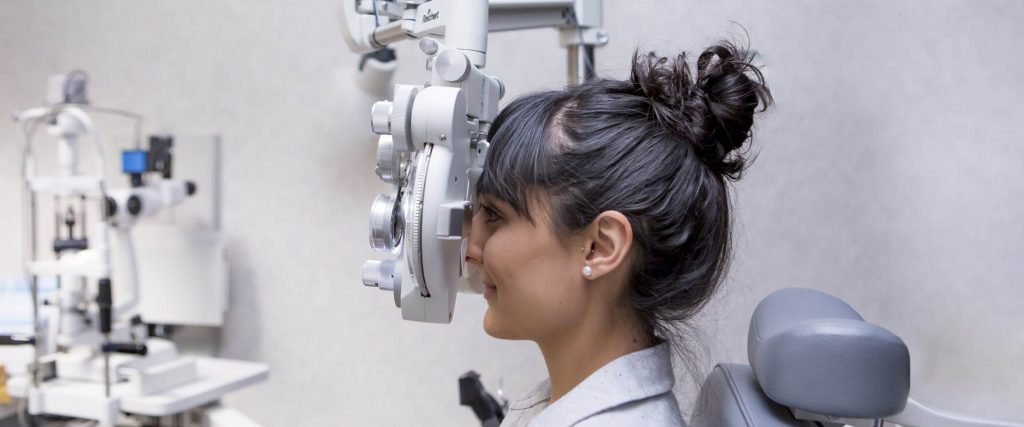
They’re also looking at the lens, retina, macula, optic nerve, eye pressure, tear film, and other parts of the eye to understand why your vision changed.
Myopia vs. Hyperopia: What’s the Difference?
The easiest way to remember it is:
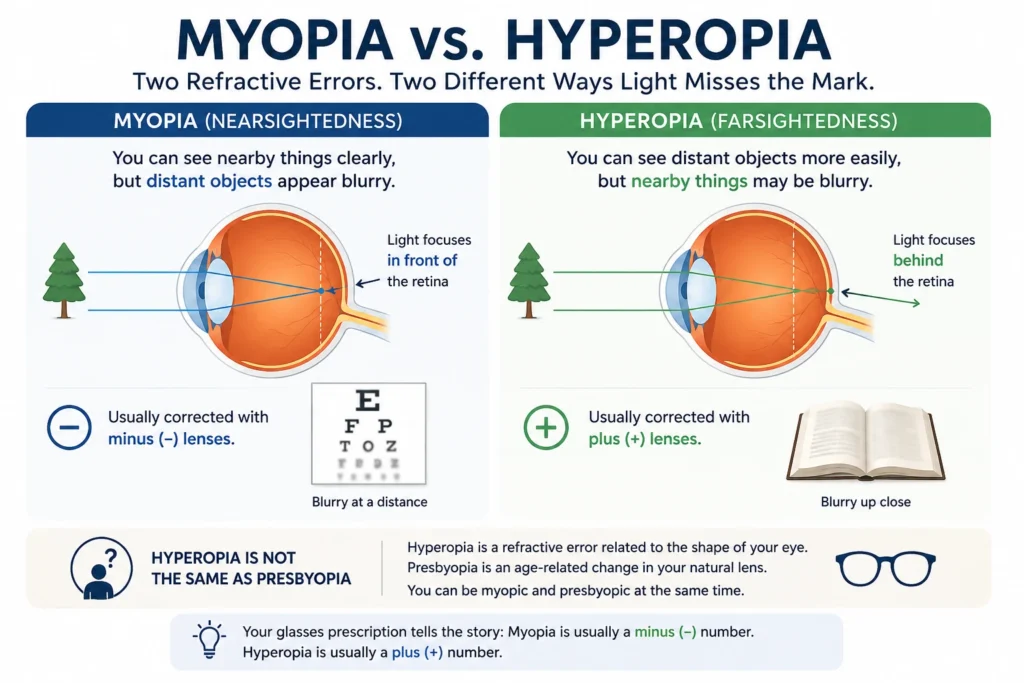
Myopia = nearsighted. Things farther away tend to look blurry because light focuses in front of the retina.
Hyperopia = farsighted. The eye’s focusing system causes light to focus behind the retina when accommodation is relaxed. Depending on the amount of hyperopia and your age, this can make near vision difficult, although some people can compensate for it when they’re younger.
Your glasses prescription gives you a clue too. Myopia is generally corrected with a minus (-) prescription, while hyperopia is corrected with a plus (+) prescription.
And here’s where people often get mixed up: becoming presbyopic in your 40s doesn’t mean your myopia has turned into hyperopia. Presbyopia happens because the natural lens loses some of its ability to focus up close as it ages. You can be myopic and presbyopic at the same time.

Can Hormonal Changes, Pregnancy or Perimenopause Change Your Vision?
Yes. Hormonal changes can affect your eyes, and sometimes the difference is noticeable enough that you wonder whether your prescription has suddenly changed.
Pregnancy is a good example. During pregnancy, changes in hormones and fluid balance can affect the thickness and curvature of the cornea and the lens inside the eye. That can temporarily change how light focuses and alter your prescription.
Some people actually become more nearsighted during pregnancy. In one study, pregnant women who reported vision changes had an average myopic shift of roughly 0.9 diopters, with prescriptions returning close to their pre-pregnancy levels after delivery. Another study also measured a smaller but significant shift toward myopia during pregnancy.
Not every pregnant person experiences this, and research hasn’t found the same pattern in every study. Larger population data suggest refractive changes during pregnancy can also vary in direction.
Pregnancy can affect more than your glasses prescription, too. Changes to the cornea and tear film can make contact lenses suddenly feel uncomfortable, even if you’ve worn them happily for years. Many of these changes settle after pregnancy, although some can persist through breastfeeding before stabilizing.
And Then There’s Perimenopause
Years later, another major hormonal transition arrives.
Changes in sex hormones during perimenopause and menopause can affect the ocular surface, tear film and other tissues in the eye. At almost exactly the same stage of life, presbyopia is also starting to make close-up focusing harder.
That can make your 40s particularly confusing if you’re already nearsighted. Your existing myopia hasn’t gone away, but now dry or fluctuating vision, changing near focus and other age-related changes may be layered on top of it.
This is why we wouldn’t automatically label every midlife prescription change as “your myopia is getting worse.”
Hormones may be part of the story. Pregnancy provides particularly clear evidence that hormonal and physiological changes can temporarily alter refraction, while research into menopause has found measurable differences in ocular characteristics and visual function.
If your vision changes noticeably during pregnancy, perimenopause or another hormonal transition, tell your optometrist. When the change happened can be an important part of figuring out why it happened.

What About Hormonal Changes in Men?
Men experience hormonal changes with age too, although they tend to happen more gradually. Testosterone and other androgen levels can decline over time, and these hormones play a role in the tear-producing and oil-producing glands that help keep the surface of the eye comfortable and vision clear.
Lower androgen levels have been associated with changes to the ocular surface and dry eye. That can contribute to blurred or fluctuating vision, but it isn’t the same thing as evidence that declining testosterone causes myopia to progress.
For men in their 40s, 50s and beyond, changing vision is more commonly a combination of presbyopia, an existing glasses prescription, ocular surface changes and, eventually, age-related changes to the natural lens and other structures of the eye.
Can You Stop Myopia From Progressing as an Adult?
If your prescription is getting stronger in your 20s, 30s or later, the obvious question is: can I make it stop?
Unfortunately, there isn’t a simple yes.
We have good evidence for several approaches that can slow myopia progression in children, including specialized contact lenses, orthokeratology and atropine. The evidence becomes much thinner when we ask the same question about adults. Researchers are increasingly interested in adult myopia progression, but we don’t yet have the same depth of clinical research telling us which treatments work, for whom, and for how long.
That makes figuring out why your prescription is changing particularly important.
If you’re 27 and your myopia has continued progressing since your teens, that’s a different situation from being 48 with a prescription that suddenly changed after a decade of stability. The second person may have other factors affecting their vision or refraction that need to be considered.
Your work and daily habits are worth discussing too. Long periods of close-up work and the visual environment are areas researchers continue to investigate in relation to adult myopia. A recent review recommends considering lifestyle and visual-environment factors even though evidence for adult-specific myopia-control treatments remains limited.
So rather than promising to “stop adult myopia,” the first step is figuring out whether your myopia is actually progressing and establishing the pattern.
Bring your old prescriptions if you have them. A change over several eye exams tells your optometrist much more than a single prescription ever could.
And if the person whose prescription keeps climbing is your child rather than you, that’s where the conversation changes considerably. We have a much larger body of evidence for slowing myopia progression during childhood.

My Child’s Prescription Keeps Getting Stronger. Is That Different?
Yes. This is where the myopia conversation changes.
If your child went from -1.00 to -2.00 and then -3.00 over several eye exams, simply replacing their glasses with stronger lenses corrects the blur, but it doesn’t address why the prescription keeps climbing.
In children, increasing myopia is often associated with continued growth and elongation of the eye. And because their eyes are still developing, there is something we can do that we have much stronger evidence for in children than adults: try to slow that progression.
This matters because the goal isn’t to get your child back to zero. Myopia can’t currently be reversed or cured. The goal of myopia management is to reduce how quickly it progresses and, where possible, limit how much myopia a child ultimately develops.
There are now several evidence-based approaches, including specialized myopia-control glasses and contact lenses, orthokeratology (Ortho-K) and atropine eye drops. Which option makes sense depends on the child, their prescription, eye health, age and other factors.
And yes, getting outside matters too. Outdoor time has been associated with a lower risk of children developing myopia in the first place, although once a child already has myopia, outdoor time isn’t a replacement for appropriate myopia management.
Why Are We Trying to Keep the Prescription Lower?
This is the part parents don’t always get told.
A -6.00 prescription isn’t simply a more annoying version of -2.00.
Higher levels of myopia are associated with increased lifetime risks of eye problems, including retinal detachment, glaucoma, cataracts and myopic maculopathy. That’s why modern myopia care has shifted from simply making the whiteboard clear again to paying attention to how quickly a child’s myopia is progressing.
So when your child’s new glasses seem to get stronger every year, that’s worth a conversation beyond:
“Okay, what’s the new prescription?”
A better question is:
“How quickly is their myopia progressing, and should we be doing something about it?”
When Does Myopia Become High Myopia?
If your prescription is -2.00, -4.00 or -7.00, they’re all myopia. But they don’t carry exactly the same long-term eye-health picture.
The International Myopia Institute defines high myopia as -6.00 diopters or more of myopia.
That number isn’t a cliff where your eyes suddenly become unhealthy. Eye-health risks increase along a continuum, and even lower levels of myopia are associated with some increased risk. But as myopia becomes higher, certain complications become more important to watch for.
The Canadian Association of Optometrists highlights retinal detachment, open-angle glaucoma, cataracts and myopic maculopathy among the conditions associated with myopia, with risks becoming particularly important at higher prescriptions.
Does -6.00 Mean I Have Pathologic Myopia?
No, and this distinction is important.
High myopia describes the amount of refractive error. Pathologic myopia describes structural changes within the eye caused by excessive elongation. They are related, but they’re not interchangeable.
So seeing -6.00 or -8.00 on your prescription doesn’t tell you everything about the health of your eyes.
And getting laser vision correction doesn’t erase that history either. Changing how light enters the eye can reduce your dependence on glasses, but it doesn’t necessarily undo the structural characteristics of a highly myopic eye. The International Myopia Institute specifically notes this distinction when discussing people who have undergone refractive or lens procedures.
That’s why someone who has been highly nearsighted for decades still benefits from ongoing eye-health examinations, even if their glasses give them perfectly clear vision.
When Should a Changing Prescription Actually Concern You?
A new prescription every few years isn’t automatically a red flag. Eyes change. Sometimes the difference is small enough that you barely notice it until you put on your new glasses and realize the street signs suddenly have edges again.
What matters more is how the change happened.
A gradual shift over several eye exams tells a different story from vision that becomes noticeably blurrier over a few weeks or months. The same goes for one eye suddenly changing much more than the other.
And sometimes what feels like “my prescription changed” isn’t really a glasses problem at all.
If your vision suddenly changes, becomes distorted, or you develop new flashes, a sudden increase in floaters, missing areas of vision or a curtain-like shadow, that needs prompt assessment. Those symptoms can be associated with problems involving the retina and shouldn’t wait for your next routine eye exam.
This deserves extra attention if you’re highly nearsighted. High myopia is itself a risk factor for retinal tears and retinal detachment.
For everyone else, the useful thing is to stop thinking about your prescription as an isolated number.
If you went from -2.50 to -2.75 over several years, that’s one piece of information. If you were -2.50 for a decade and suddenly need -4.00, your optometrist is going to be interested in why.
Bring your old prescription if you have it. Even better, keep having your eyes examined in the same place when practical so there is a history to compare.
Sometimes the most useful information in an eye exam isn’t today’s number.
It’s the pattern.
Adult or Child: What Should Happen Next?
By this point, you can probably see why “I have myopia” isn’t enough information to decide what happens next.
The path for a 32-year-old whose prescription has barely moved in five years can look very different from the path for an eight-year-old who becomes more nearsighted at every eye exam.
If You’re an Adult and Your Myopia Is Stable
For many adults, myopia eventually settles into a fairly predictable prescription. The International Myopia Institute reports that about 90% of people with juvenile-onset myopia were stable by age 21 in the studies it reviewed, although adult progression can still happen.
If your prescription is stable, the conversation generally shifts away from “How do we slow this down?” and toward:
Are you seeing comfortably, and are your eyes healthy?
That might mean glasses, contact lenses or discussing other vision-correction options. If you have high myopia, regular eye-health assessment remains important even when your prescription hasn’t changed.
If Your Myopia Is Still Changing
Don’t assume you’re simply destined for stronger glasses every year.
Looking at several prescriptions over time can help establish whether there is a genuine pattern of progression. In younger adults, ongoing axial elongation can occur, although progression generally becomes less common and slower with age.
A change after years of stability deserves context too. As we’ve covered above, the prescription can be influenced by more than myopia alone.
If It’s Your Child’s Prescription That Keeps Changing
This is where we’d have a different conversation.
Children tend to have more potential years of progression ahead of them, and younger age at onset is associated with faster progression. Unlike adult myopia, there is also a substantial evidence base for treatments designed to slow childhood myopia progression.
Rather than simply updating the glasses again, it may be worth asking:
How quickly is my child’s myopia progressing, and should we be managing the progression itself?
FAQ about Myopia Management
Why Is My Night Vision Getting Worse Even Though My Prescription Hasn’t Changed?
Low-light vision can expose blur and optical imperfections that aren’t as noticeable during the day. Larger pupils, glare, dry eye, cataracts, and an outdated or slightly undercorrected prescription can all contribute to difficulty driving at night. There is also a phenomenon called night myopia, although research suggests it doesn’t explain every case of poor night-driving vision.
Why Can I Suddenly Read Better When I Take My Glasses Off?
Removing your distance glasses lets your existing myopia work in your favour at close range. It doesn’t mean your myopia has been cured. You can have myopia and presbyopia at the same time.
My Prescription Got Weaker. Does That Mean My Myopia Is Reversing?
Not necessarily. A prescription can shift for several reasons, including age-related changes inside the eye. A smaller minus number doesn’t necessarily mean the underlying anatomy associated with your myopia has reversed.
Why Does One Eye Keep Getting More Nearsighted While the Other One Stays the Same?
Your two eyes don’t always change at exactly the same rate. A growing difference between them is worth tracking, particularly if the change is new or significant, because your optometrist can look beyond the prescription to understand what is causing it.
Can My Eyes Be Too Nearsighted for Glasses?
There isn’t a single prescription where glasses suddenly stop working. Very high prescriptions can, however, create practical issues with lens thickness, magnification, peripheral distortion and frame choice. Contact lenses may provide different optical advantages for some highly myopic people.
Why Do My Contacts Suddenly Feel Wrong When My Glasses Prescription Seems Fine?
Because clear vision isn’t only about your prescription. Contact lenses sit directly on the eye, so changes in the tear film, ocular surface, lens fit or cornea can affect how comfortable and clear they feel even when your glasses still seem fine.
Can I Make My Myopia Worse by Wearing the Wrong Glasses?
Wearing an old or incorrect prescription can certainly make vision blurry or uncomfortable, but deliberately wearing weaker glasses isn’t a proven way to stop myopia. In children, undercorrecting myopia is not recommended as a myopia-control strategy.
I Had LASIK, So Why Does My Optometrist Still Say I’m Highly Myopic?
Laser vision correction can change the focusing power of the eye so you no longer need a -7.00 pair of glasses, but it doesn’t necessarily erase the eye’s history or structural characteristics associated with high myopia. That’s why your previous prescription remains useful information for your optometrist.
Medically Reviewed by Dr. Amit Sahota, Registered Optometrist (BScOD)
Aug 8, 2026